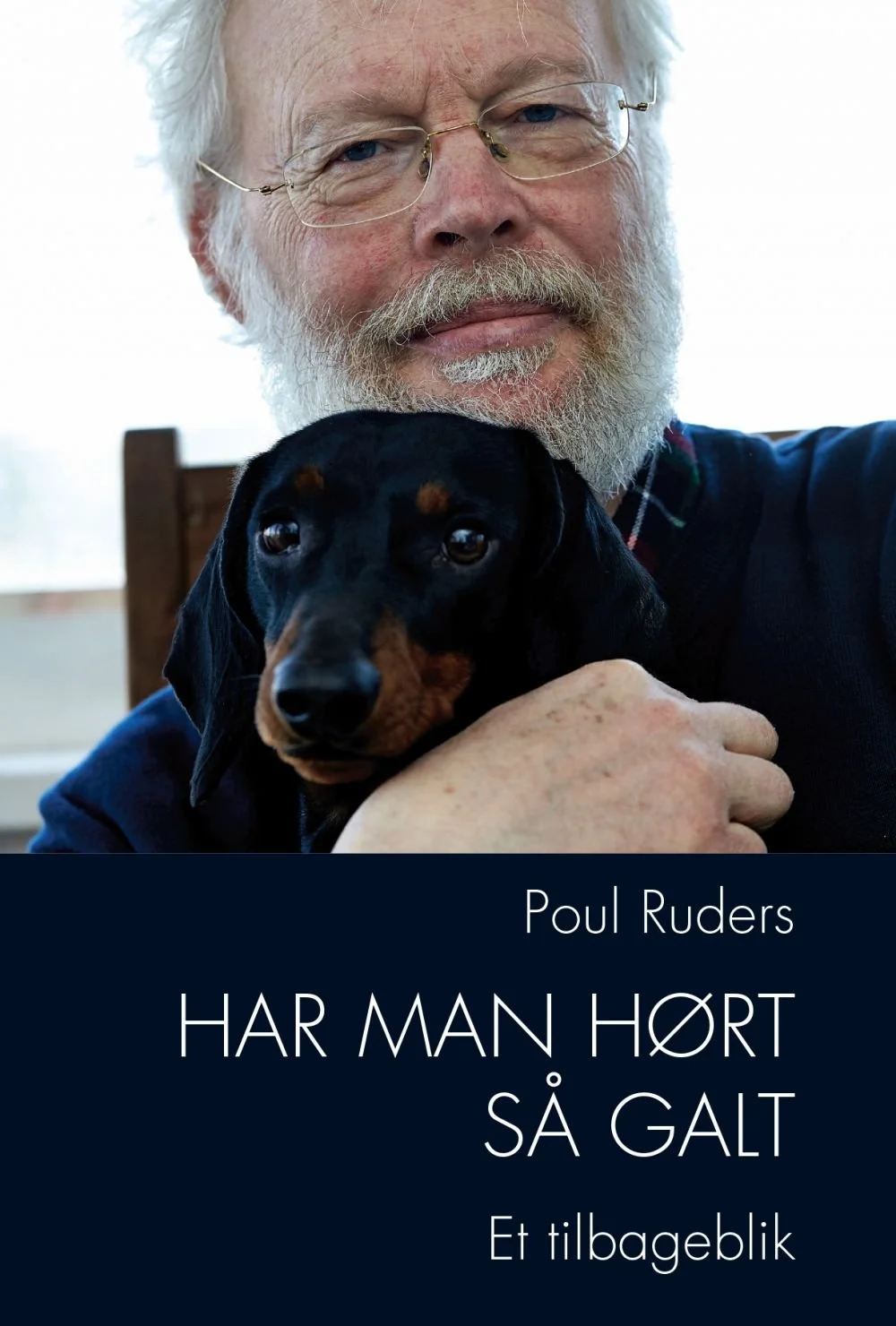
Would You Believe It: A Look Back (2000)
"Would you believe it - a look back is a translation from the original Danish of my short autobiography Har man hørt så galt - et tilbageblik, published in 2019 by the independent Danish publishing house Kahrius.
The book, which was launched as part of various activities in connection with my 70th birthday, is a personal "fact sheet", a frank and unpretentious walk through my life, from when I was born in 1949 up to the composition of my opera The Thirteenth Child in 2018".
Cover photo: Lars Skaaning
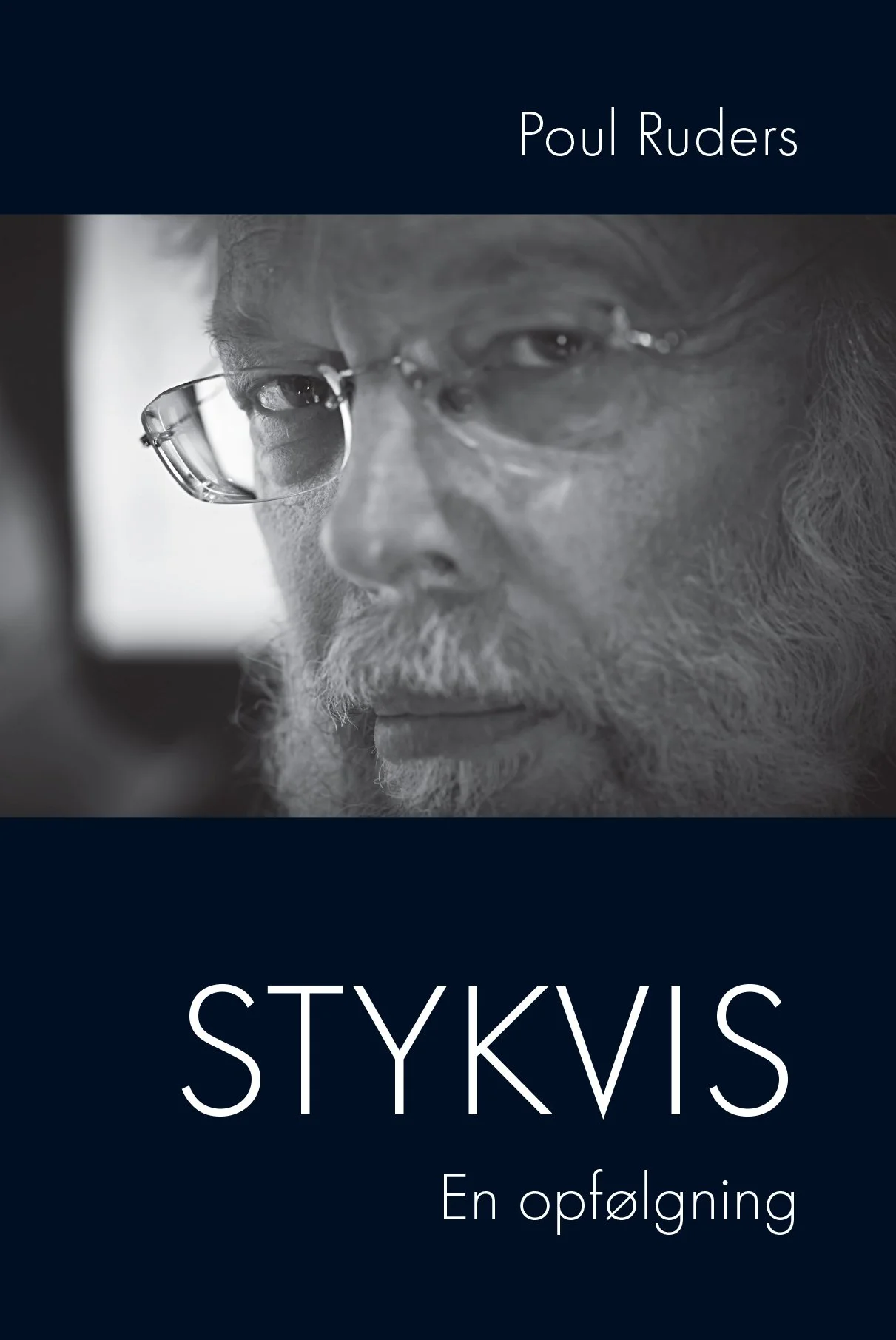
The following is a translation, from the original Danish, of the composer´s 2024 book "Stykvis", in English "Pieces", the personal story behind 10 selected compositions, from 1967 to the present day
Cover photo: Lars Skaaning
Introduction
“You could make a drawing of me like the ones slaughterhouses show of pigs, where it says ham, neck, shoulder, and so on.”
— Poul Ruders (Danish Music Journal no. 6, 1985/86)
The musicians float freely in mid-air, gravity suspended. The accordion virtuoso somersaults several meters above terra firma. The young female star on the violin—the record company’s latest darling—photographed with pouty lips, casts languid eyes over her bare shoulder. The conductor hasn’t shaved for days and appears solemn with half-closed eyes.
Welcome to the enchanting world of classical music—or rather the world as it appears on CD covers, in program booklets, and on websites. The stuff has to be sold, after all. Youth (that golden calf around which the panicked music industry frantically dances) must damn well learn to understand and love, until death do them part, the supreme position of classical music in a brainless world of noise, nonsense, and pop. Come on in—we’re much better than our reputation. Classical music isn’t boring at all. Believe us, it´s dripping with sex and rhythm until dawn. Whoopee! Off we go.
And it’s true—no other music has more to offer. A bottomless treasure chest of beauty, drama, wit—everything the heart, brain, and ear could desire. And yet, classical music (the word classical itself is a disaster, reeking of graduation caps and black suits) has been placed, once and for all, on a pedestal, from which it looks down upon the poor sods who haven’t been admitted to the innermost sanctuary.
The Swedish satirist Albert Engström once captured this skewed relationship in an unforgettable cartoon: A stiff aristocrat in white tie, monocle and cigarette holder, says to a friend—probably the doctor—after a fine dinner in the gentlemen`s smoking room: “…tell me, you who frequent the lower classes—do they have pianos down there?”
Intellectual condescension whenever “culture” comes up—a disdain often rooted in abysmal ignorance of “other” lives—is nothing new. The Polish composer Krzysztof Penderecki (1933–2020) once remarked in an interview that classical music, like philosophy, is not for everyone.
What if he was right? A depressing thought. I don’t buy it. Music and profound thought are for everyone—or at least ought to be. There’s nothing in the constitution that says only children of doctors and lawyers may play the piano or violin. Or study at university. Still, I’m well aware that social background largely determines which path we follow in life. And that’s where the exception appears: deviation from the social heritance.
At high school I shared a class with a boy whose father was a construction worker and whose mother was a homemaker. Their circumstances didn’t allow for philosophical contemplation, and Bach and Beethoven weren’t exactly household names. And yet classical music (which made up a huge part of the curriculum at Sankt Annæ Gymnasium, from which we both graduated in 1968) came to mean the world to my friend.
Because he was musical.
And that’s enough. But what musicality is, and where it comes from, I have no idea (and I’ll steer well clear of the “roaring forties” of the “nature versus nurture” debate). Let me start with myself, as the dog said. Why do tears spring to my eyes the moment I hear the opening chorus of Bach’s St Matthew Passion? And when we reach that majestically rising bass line a few bars later, I’m done for. The choir enters, and I’m reduced to a wailing wreck.
It’s not the story that follows over the next three hours that brings me to my knees. I’m equally undone when I hear the slow movement of the secular Concerto for Two Violins. But the St Matthew Passion—the greatest musical work in Western cultural history—is the deepest, most unfathomably moving dramatization of an event that… never happened (I write this entirely at my own risk!). “Without Bach, God would be a third-rate character,” as the Franco-Romanian philosopher Emil Cioran so aptly put it.
And still, I have no explanation for why music “does something” to me, and has done so since I cut my first teeth. In my childhood home there was a piano, where my mother (who had learned to play as a young girl) would sit, though rarely. That she was musical is beyond doubt—she also had a fine singing voice. My father, who didn’t grow up with a piano, nonetheless acquired and enjoyed gramophone records (the old black shellac discs spinning at 78 rpm, later LPs at 33 rpm), with music mostly by Haydn and Vivaldi. And his father, a level-headed businessman, loved the operas of Verdi and Puccini. He came from the humblest of backgrounds in northern Jutland—so where did he get his musicality from? It wasn’t just the stormy heights of passion that drew him to the theater. Genes always surprise us.
Some people hum and whistle a tune the moment they’ve heard it. Others definitely don’t—perhaps the same ones who can’t tell whether an interval goes up or down. Are they unmusical, or tone-deaf? Not the same thing. Or is it? In Western culture, tonal music (the system of major and minor keys) has only been around for a little over three hundred years—a blink compared to modern mand´s 300,000 years on Earth. (In my autobiography “Would you believe it” I put it at 150,000 years, based on consultations with Moesgaard Museum, but newer research doubles that span. The Homo sapiens model at the museum has since aged another 150,000 years!)
The Austrian composer Arnold Schoenberg, credited with inventing the twelve-tone method (placing all twelve chromatic tones on equal footing), was convinced that street urchins would be whistling his atonal melodies in his own lifetime. Needless to say, that didn’t happen.
My professional choice, however you look at it, is rooted in the joy of the kind of music written by white men, long dead, mostly German and Austrian. Classical music again (which of course includes the atonal repertoire too). But that still doesn’t fully explain why I am the way I am when music plays.
Once in an interview I claimed, “…I’m ridiculously musical.” It may sound a bit cocky, but I smoothed it out by continuing: “…in the sense that music never leaves me alone. Everything goes in one ear and stays there.” That’s not especially advantageous for a composer, who needs a clear head. So in daily life I’m very, very selective about listening to music. In fact, I almost never listen to any—especially not when I’m composing. Just reading the title of a piece I know is enough to trigger the inner soundtrack. Goodbye, sleep—for several nights in a row.
In my quickly read autobiography I tell about my life as a composer and how I gradually found my footing in this peculiar trade. Out of the many works from 1967 to 2018, I only delved behind three in detail: Psalmodies for guitar and chamber ensemble (1989), the orchestral Concerto in Pieces (1995), and the opera The Handmaid’s Tale (1998).
In what follows, I’ll try to recall the events, coincidences, personal encounters, and inner reflections (including frustrations) that accompanied the composition of the following works:
• Monodrama (1988)
• Symphony No. 1 (1989)
• GONG (1992)
• Serenade on the Shores of the Cosmic Ocean (2005)
• Sound and Simplicity (2018)
• Light Overture (2006)
• Handel Variations (2009)
• Harpsichord Concerto (2019)
• The Thirteenth Child (2016)
• Three Letters from the Unknown Soldier (1967)
What follows isn’t technical analysis but rather my own reflections on what it really means to compose—not only these works but composition in general. For those craving detailed analysis, I highly recommend Per Erland Rasmussen’s 2007 monograph Acoustical Canvases: The Music of Poul Ruders. The book covers my music from 1967 through The Handmaid’s Tale (1998).
In the bittersweet British film Venus (2006), Peter O’Toole plays a once-famous actor now spending his remaining time in the pub with another has-been actor, reading obituaries of their peers. They discuss how much column space each one got, how far into the paper the notice was printed, while speculating on how much attention they themselves will receive when their turn comes.
I haven’t quite reached that stage yet, but I’ve passed 74, and not long ago I read in an English-language article that I’m now “a grand old man.” Let’s repeat that… no, I can’t bear it. When an artist—composer, author, director, actor, etc.—is branded a “grand old man,” that’s the end. I picture myself as an old geezer in a rocking chair on the veranda, eyes watering, wrapped in a thick blanket tucked around my legs by the missus, mumbling about the good old days when…
… I, on New Year’s Eve 1987, dropped my luggage on the floor in the empty apartment in a modern housing complex by Columbus Circle in New York City. The apartment, an ordinary two-room affair that at the same time doubled as the US Office for the English music publisher in London, Chester Music, a sister company to the music publisher Wilhelm Hansen in Copenhagen, had been placed at my disposal for a couple of days, as a “base,” before I moved more permanently to an apartment in Brooklyn, which I had rented for three months. My “exile” sprang from a wish that had lain and fermented for a couple of years at the back of my mind, to set myself up and work in New York for at least three months, or more precisely, the 90 days a tourist visa permitted. On the home front my marriage to my then wife Helene had gone pear-shaped,, but we had not yet divorced, lived each on our own. She at our former shared house in Virum, while I bought and set up shop in an apartment in Burmeistergade at the Copenhagen borough of Christianshavn.
And it happened in those days, the spring of 1987, that I received a commission for a composition from the Danish Radio Symphony Orchestra, RSO, more specifically a percussion concerto with the orchestra’s virtuosic percussion master Gert Sørensen in the “leading role.” The premiere was then supposed to happen with much ado, as part of the Danish Composers’ Association’s 75th anniversary, 5 December 1988.
At that time, 1987, I was still organist at Mariendals Church in Frederiksberg, so I could not just up and leave to stay abroad; I had to apply for leave from the post—and it was granted. The apartment on Christianshavn I sublet to a grand- cousin.. When he asked me whether he could move the furniture around while I was away, I said: “… no problem, you can shove the sofa out in the bathroom if you wish, as long as it stands where it stands now when I come back!”
Chester Music’s office in New York had for several years been led by the Englishman James Rushton, and I had myself on several occasions lived there as his guest (free hotel, if truth be told), because the apartment also doubled his home.. There was everything necessary, kitchen and bath, two toilets and guest room. In other words, I felt at home when I put the key I had been given down at the porter’s, the doorman, into the key hole.. James Rushton had in the meantime been called home to the London office, and the position as Chester Music’s man in New York had now been transferred to a native New Yorker, a Mr. Copeland, who in the months before my arrival had sought—and found—an available apartment for sublet and immediate takeover in the borough of Brooklyn, one of the five so-called boroughs.
Why I had chosen precisely to begin my temporary exile on New Year’s Eve remains uncertain. I arrived at the high-rise complex The Beaumont in West 63rd Street, around 10 o’clock in the evening, and things were already heating up for celebration down on the streets. I stayed, however, “at the office,” all alone, for the new branch manager lived elsewhere. The apartment now functioned solely as an office. When I could sense that the inevitable jet lag had begun to creep up on me, I had more need for pillow and duvet than pranks on Times Square.
The next morning I hoisted up my unusually large, heavy, and clumsy duffel bag, which I had bought at home at a surplus store, and set course for Brooklyn Heights. Since I had been in New York several times before, I knew exactly which subway ran under the East River and into Brooklyn. Line No. 2 Express from 72nd Street, or the “milk run”, line no 1 from Columbus Circle.
I had arranged a meeting and handover of the key on site with the owners, Carol Weaver and her husband, during the course of the morning. I did not know them, for obvious reasons, but we “clicked” well, and after having been thoroughly instructed in how washing machine, stove, et cetera, worked, I was left to myself. In the literal sense of the word. Only very, very few people knew where I now was, here on New Year’s morning, 1988: State Street no. 10, Brooklyn Heights, NY, NY. E-mail, Internet, and mobile phones lay far out in the future, and my only technological access to the outside world was an ordinary landline telephone.
I had come primarily to write a larger work of half an hour’s duration, preferably finished during the three months I was allowed to be in the USA, so there was no time to waste, so better get fracking right away. It would, after all, have been obvious, had I stipulated that a piano be installed in the apartment, but I didn´t
The work I intended to write during my stay in New York was, in my inner “archive,” already sketched for percussion, a lot ofpercussion, and symphony orchestra without violins and violas. But still, surely a piano is alpha and omega when one composes? Not necessarily. It is difficult to understand if one is not oneself in the trade, but a composer “hears what he sees,” can immediately hear with his inner ear how it sounds, what he writes down—should preferably be able to hear it, and more than just approximately. It certainly does no harm just to try out whether everything is now “hunky-dory”. But here, in the present case, where the emphasis lay in the percussion, I was more focused on the rhythmic progression, timing, a carefully calculated time course, a journey in sound, from start to finish, without pit stops in the form of movements and sections along the way.
That required meticulous planning on graph paper, so that was part of the “equipment” I first unpacked and laid in a neat pile to the right on the folding camping table, which was one of the few pieces of furniture, plus a bed and two chairs, which the Weaver couple had left. But first I just had to go down and out into the street and get to know the neighborhood. There were shops enough, and restaurants, and a bustle of people in every desirable and conceivable guise. The nearest subway station was Borough, the first in Brooklyn on lines 1 and 2 from Manhattan.
There was a rich selection of pubs, many of them Irish, but there was no lack either of authentic American taverns. Even though at that time I was balancing, with great risk of falling down and hurting myself, on a tight and thin wire with harmless cozy drinking on the one side and… catastrophe on the other, I naturally also had to see whether there was a place I could “adopt” as my “ regular watering hole while staying in the neighborhood. There were several varieties to choose from, and my pledge not to come to grief in the three months was honored. There was only one thing on the program: to compose. But we must, then, just step inside at Moloney’s. The first thing that strikes one when stepping inside is the televisions running up on the wall behind the bar and in the corners. But always without sound. On the one screen one sees two large half-naked, sweating louts jump around in gaudy underpants while they punch each other in the face; on the next screen a bunch of giants toil and push around on skates while they all the time try to hit one another’s shins with some long flat sticks. I look around the room, which is not even half filled with customers. The few who sit at the bar are not looking at the televisions but are reading the paper or something that looks like racing sheets.
It is the middle of the day, and the lunch rush can surely not be long in coming. Lunch, midday meal…
For the likes of me, too lazy to stand in the kitchen and cook for just myself, New York is exactly the right place. Everyone is busy, rushing around from one meeting to the other, there is big business everywhere, so many New Yorkers never cook at home but get it brought in, call out for food, or take it home directly from a restaurant or a delicatessen.
At that time, in the late eighties, a Korean food chain had great success with their concept: fresh vegetables stacked up in tempting pyramids outside; inside one could take a foil tray at the entrance and then help oneself, with everything stomach and palate could desire, from an enormous buffet in the middle of the room. It was delicious, the selection almost endless, and… cheap. So it was not long before I became a regular down at “my” Korean on the corner. Unfortunately, only a few years later, competition broke out among the different shops in the chain, a situation that escalated and ended in violence and vandalism, and the chain as such was dissolved.
But of course I had come the long way to compose, not to lose myself in noodles and fried squid. Up in the apartment on the second floor the necessary papers, erasers, and sharpened pencils now lay ready and waited for me… who also waited for them, my tools of the trade, so I sat down at the camping table and… began.
Music moves in time, that is no secret, but as is well known no one can explain what time is. Albert Einstein once said that the sense of time as something that moves horizontally from one place to another is an illusion, albeit a very convincing illusion. Time does not exist, time does not pass, it is we who pass—all of it fascinating and without doubt correct. I am not a natural philosopher or cosmologist and promise to keep away from further speculations. But one thing is certain: when we sit in the chair in the concert hall and listen, then the illusion of time as something tangible, progressive, is not an illusion but a reality. We have all sat and writhed in the seat and looked, groaning, at the clock when a piece seems endless (and it will always be music we do not like): isn’t it soon over, for heaven’s sake… this is taking far too long, get it over with. Conversely, when music that really grips us stops before we think it ought to, then the work is too short! (It is almost a rule of the thumb, that when a piece by a living composer lasts more than half an hour, the reviews say that it is too long. One may harbor the suspicion that the composer thinks he is somebody, whereas when there´re hour-long tooth-pullers by Bruckner and Mahler on the menu, well, that´s all okay, for they are… classics!). Nevertheless, in the face of those considerations, I was determined to write a work of half an hour’s duration, beginning almost inaudibly, and which was slowly to build itself up toward an orgiastic climax, and I must, must, must absolutely not give in, slacken the reins, cave in and seek harbor before time (that was a little metaphor mix for the evening coffee…).
Timing, timing, timing!
Graph paper? That does not sound particularly musical, but that was precisely what I needed when I laid the foundation, so to speak, for the whole progression. The music, ie. choice of tones (to rub in the self-evident), had to wait until the “floor plan” had been fully worked out. On the graph paper I could first draw long lines with pencil, lines which then again could be divided into bars. Then stopwatch and metronome.
It was my plan start way, way down in the depths, as mentioned before almost inaudibly, and then gradually turn up the volume, and patiently add more and more beats into each of the four quarter-note beats in each bar, which was to constitute the only time signature in the entire piece (and came to do so). It is a widespread misunderstanding among composers today that the more notes one stuffs into each bar unit, the faster the music becomes. But it doesn´t. The result is a string of tone garlands, which indeed looks busy,, but fast it is not. The note activity within the individual bar division is indeed intensified, but the pulse is still the same, for example 60 beats per minute, which is not particularly fast. It is the pulse alone that decides whether the music is fast, slow, or in between. In 1986, during a visit to the Tanglewood Festival in Massachusetts, I gave a lecture for young composition students about “compositional endurance.” That is, how one keeps “the pot boiling” at the writing desk and the piano without keeling over. The emphasis was on how to write really fast music.
For that is “the test,” being able to write a hell of a lot of of notes, page after page after page, and the whole should then preferably progress smoothly. When you think that now at least five minutes must have passed and you check with stopwatch and metronome, the smile stiffens - not even a minute has passed! Then up in the saddle again. It is not for the squeamish. But it helps if one has a “plan,” such as a system which, from its own logic, sets the agenda. I myself for many years, right up into the late nineties, used the old English change-ringing system, where each (of my own “invented”) passage indeed appears again and again, but never in the same place in the progression. The order is never repeated and stops only when the permutation (as it is called) has run its course and is about to start over. A system like the above, has nothing to do with music; it is pure number gymnastics. Since I myself suffer from a mild form of number blindness (dyscalculia), I not infrequently, in the many change-ringing-generated works, happened to “count wrong,” but discovered it in time, and if not, I made a virtue of necessity… that is, human intervention (it is said that Beethoven suffered from the same handicap, so I am in good company…).
I urged the young people to invent and use anything whatsoever within the bounds of the law in their efforts to write long courses with a fast pulse. All composers, high and low, have used systems, including the old masters. But naturally, the system must never be audible when the music plays. That is the real art.
When after a month of intense work I had “drawn” the progression, that is, the rhythmic ground plan, it was time for the tones. And there was no shortage of time in my self-chosen isolation. For I had truly shut myself in for almost three months, had only few visits, but did from time to time go out into the city to visit friends and acquaintances. There was no television in the apartment, only a transistor radio. A couple of concerts and a quick trip to the cinema - and two trips out of town: to Yale University and… Tokyo!
Before I went to New York I received an invitation from the composer Jacob Druckmann, professor of composition at Yale University School of Music, to stop by his class and tell about my music. Yale sits in the city of New Haven, in the state of Connecticut, only an hour and a half by train from Grand Central Station. The excursion could be carried out in one and the same day. And it was, a welcome break in the daily routine in Brooklyn. My presentation in front of Druckmann’s class proceeded by the book: blah, blah, blah, playback of a little music on cassette tape (!), polite questions from the group, polite applause—and bye-bye and thank you very much.. My visit must nevertheless have made a certain dent, for I was asked during the lunch break whether I might like to become visiting professor for a time in one of the nearest spring semesters. That did not sound half bad (yet another excuse to disappear into the blue). The project was realized in the spring of 1991, after I—again—was granted leave from my position as organist in Frederiksberg.
Back in State Street the notes awaited… the music was now to begin to take form.
It was back in the 1960s, in the high-school time and a couple of years onward, that the desire to compose began to grow and slowly dominate, in competition with the parallel project of becoming an organist. The latter one can learn, the first one is born to, but the road is long. For most. My designated route wound in hill and dale and through darkest nooks and crannies until I got “all my ducks in a row” with the chamber work Four Compositions from 1982. It may seem a bit suspicious that I so shortly after the piece’s success at its international debut in London, 1982, was invited to teach at a prestigious American university and received large commissions for works from near and far. Four years later my orchestral work Manhattan Abstraction, conducted by Oliver Knussen at the Tanglewood Festival, was performed. Then things moved fast, Corpus cum Figuris with the New York Philharmonic and what have you; the gates toward golden times stood wide open. I had indeed established myself solidly, both at home and abroad, but it was—and still is—a journey with obstacles, mostly obstacles, placed by myself, in front of me. Today any idiot who has learned to notate music and with some rudimentary technique and knowledge of the instruments can in fact get away with anything—and even achieve success! In other words, because composition has been watered down as a subject, not to mention as an art form, has become too easy, it is imperatively to make it difficult again, to raise the bar for oneself.
From time immemorial (when I was an idiot, even without the most elementary knowledge of the instruments), and I myself slowly began to try my hand in the trade, it did not take long before I
ran into the wall that at all times towers up before all composers: how do I move ahead without grinding to a halt? Even today, when I undeniably have great experience (some would say: and with my whole future behind me), the process of getting from A to B to C, etc., is still a challenge, and it ought to be so. Something must continually be “thought up,” and this “something” should preferably be worth listening to. That simply and squarely is how linear composition can be defined. The horizontal composition process belongs to Western musical culture. In the Orient time perception was and is, also in music, completely different. The Japanese composer Tōru Takemitsu (1930–1996), who wrote (for the most part) for Western ensembles and orchestras, nevertheless maintained, and with colossal conviction, the vertical music perception, method, or whatever one wishes to call it. For he was precisely formed by the Oriental tradition. He said himself about his music that when one listens it is like a stroll in a Japanese garden, where one stops all the time, admiring the various fine things, a little bonsai tree perhaps, a charming bridge that arches over a brook, a pagoda, a fish pond, etc. Only very few composers formed by the Western tradition have, with success, been able to relax the horizontal regimen and compose more in sections that are not necessarily intimately and logically connected, that is, where A naturally gives rise to B, which again, etc. Claude Debussy, Igor Stravinsky, and the Frenchman Olivier Messiaen are the three geniuses I will claim have created works that revolutionized the structural form in Western music.
So there I was, after a month of intense rhythmic construction of the percussion concerto, and was about to “add colors ”; now I had to face the music, literally.. It was my first attempt with separated construction, first “skeleton,” then “flesh” (but was used again during the preparations for my First Symphony), and I had from the start decided that the orchestra should lipstick closely -, I am tempted to say - up against, the percussion, almost like a second skin. The orchestral writing must at no point stick out and set itself free of the pulse and the rhythmic drive.
The music itself consists predominantly of scales that follow the growing activity in the percussion, which gradually begins to “warm up,” in order to reach the high point via colossal wave movements; the work’s absolute climax lies displaced, off-center, which I compose toward at full gallop, with a dagger between the teeth and a blazing pistol in each hand. There is “no mercy” to be had; we are definitely in the red zone. The work ends with 7 strokes, executed with the utmost force by the soloist, on the bass drum. But I still had no title, and the child must indeed have a name.
One evening when I sat and minded my own business down at Moloney’s, it struck me: MONODRAMA…
The year before I wrote a piece for piano and the English chamber ensemble Lontano with the Dane Poul Rosenbaum as soloist: Dramafonia, that is, drama-sound, likewise a composition with a soloistic “leader,” in reality a mini piano concerto, but of a wholly other, I was about to say loose and capricious, nature than the percussion concerto. Now I was coming to the end with an almost fanatical forced march without “holes,” so to speak. So what could be more natural than to continue with the opposite of the little, restless piano concerto—with a Single- or Mono-drama? It was here, in State Street, that the seed for my 3 Trilogies was laid: the Drama Trilogy, the Nightshade Trilogy, and the SolarTrilogy.
But the seed sprang from a literary inspiration. One of the first things I did, just after I had moved into the apartment, was to study the contents of the only “inhabited” bookshelf that remained. I am an insatiable reader of novels, and after having riffled through a couple, I came across a book by a completely to me unknown author, the Canadian Robertson Davies. “The Rebel Angels” it was called. I began to read, as always an hour before falling asleep. But I did not sleep; I became so absorbed by the book, which I learned was the first part of a trilogy, “The Cornish Trilogy.” The next day I found myself in one of the many well-stocked bookshops in the neighborhood and bought not only the rest of The Cornish Trilogy but also The Salterton Trilogy and The Deptford Trilogy. Robertson Davies has since then been one of my absolute favorite authors.
And not only because he inspired me to write trilogies myself…
We had now arrived at March, the third and last month of my stay in New York. In the summer of 1987, during a visit to England, I received a phone call from Louise Lerche, director of the Lerchenborg Music Festival. Louise was at that time in close contact with the Japanese pianist Aki Takahashi and had visited Japan several times. I was invited go with her and the composer Niels Rosing-Schouw to Tokyo the following year. Niels was to have an orchestral work Twofold performed and I… a piece for Alto Flute and Foot-bongos! Carnival. A highly peculiar program combination, but why not? And why not say yes to a trip to Japan, all expenses paid? So, still with a not entirely finished percussion concerto lying on the camping table, I flew to Tokyo with United Airlines from Kennedy Airport. 14 hours non-stop. That the entire New York City Ballet was on the plane added to the entertainment. We had hardly reached cruising altitude and the captain turned off the fasten seat belt sign before the ballet corps jumped over the seat backs, back and forth, did flip-flops in the aisles, so the flight attendants had to intervene and call to order. At Narita Airport I was then, according to agreement, to wait for Louise and Niels, who had flown over from Copenhagen via Anchorage in Alaska. They joined in the arrival hall precisely at the agreed time, and so did a driver hired for the occasion, who was to drive us to our hotel at the opposite end of Tokyo.
Which is big, very big…
The drive took 5 hours, and I had to pee like hell…
After the concert (I do not remember where and with which orchestra and who else played; the whole project was very low-key), where the program consisted of only Danish music: Rosing-Schouw, Ruders, Gudmundsen-Holmgreen, I had a couple of days to myself, during which I decided to put myself to the test, travelling on Tokyo’s Metro during rush hour. I had, like so many others, seen TV programs where white-gloved employees physically stuff people into the train before departure. They actually did; I had the pleasure myself… My primary goal for the day’s outing was, however, prompted by the wish to see with my own eyes the famous volcano Fuji. At the hotel the English-speaking receptionist could tell me precisely how many metro stops there were on the trip from the nearest station to the railway station from which a local line serviced Fuji-san. Since all signs were only in Japanese, the only way I could be sure to get off at the right station was to count on my fingers and hope that luck would favor the bold. It did. How I then found the right train in the direction of Fuji is still a mystery to me. But I found it—and arrived safely at the place where I was to get off to find the circular cable car bringing tourists comfortably and at a sedate tempo around the iconic mountain. And I really got to see it, which is far from certain, since the top of the volcano, the cone itself, is mostly shrouded in clouds. I was more than lucky, one must say. And miraculouslyI also succeeded, without getting lost, even after having jumped aboard a bus where the destination was written only in Japanese, in finding a nearby station where I could get back to Tokyo with the legendary high-speed train Shinkansen.
But of course I had to get home to New York and get on with finishing the percussion concerto. Upon arriving at Kennedy Airport I became slightly confused when I bought the day’s paper and looked at the date. But it was yesterday? How was that possible? Then it dawned on me: I had crossed the International Date Line and “won” a day. Precisely like Phileas Fogg in Around the World in 80 Days, which made it possible for him to be in the Reform Club on the right day just before the clock struck 12 and thereby win the wager. Had he traveled the opposite way, he would have lost.
It also happened, by chance, to be my birthday, 27 March 1988, so I had my birthday two days in a row! The last I celebrated in solitude, in my bed, knocked out by a more than ordinarily violent jet lag. That, and a strong sleeping pill, meant that I could sleep 12 hours straight. It helped, but my time in New York was about to run out, and I had not completely finished with Monodrama, but leaveI had to.. True, I was not entirely finished with the piece, but the score had accumulated considerably,, so it´s hardly that I took it with me up into the plane. I would have none of having it stowed in the hold in the duffel bag together with a mountain of other people’s suitcases. I had no copy, so I sat with the many manuscript pages on my lap during the long trip home. I let myself into the apartment, Burmeistergade 3, 5th floor to the right, now after almost 3 months abroad. The sofa stood where it stood when I left…
The concert where MONODRAMA was to be performed was set for 5 December the same year, so there were not oceans of time left. I managed, in relatively short time, to complete the piece by hand, not printed (that was long before computer engraving was invented), but photocopied and passed on to my faithful parts copyist Ole Thilo. He then wrote out in separate booklets (the so-called parts) by hand what each individual instrument was to play.
The concert itself was on the verge of being cancelled, as the conductor Michael Schønwandt had contracted tonsillitis and was in an extremely bad way. The conductor Frans Rasmussen was called in as possible eleventh-hour replacement. Schønwandt would not give up, however, swallowed a mountain of pills, and the concert, which besides Monodrama also offered works by Per Nørgård, Rued Langgaard, and Carl Nielsen, proceeded as planned.
Was I myself satisfied with my work? One is never completely satisfied; there is always something, always a pebble in the shoe. As, for example that I, when the music had begun to grow, could not restrain myself from borrowing from myself a passage from the prelude to Act 2 of my capsized opera Tycho, Stjernemusikken(Atar Music). There is nothing wrong with the music in itself, but it deflated the intensity a bit. Fortunately, it appears for only a short (more or less) time, and I “repaired the fence” again.
In the program note, that is the “user guide,” where the composer writes a little about what he has envisaged and which is printed in the program, I had written the following, not a little aggressive, manifesto:
“As a composer I do not believe in music’s direct function as social transformer or usurper.. But music’s unique inherent, indirect metaphysical power gives the composer the possibility to rattle the bars and shout at the prison guards: the bureaucrats, the politicians, the reactionaries, the philistines, the xenophobes, the polluting swine, the prophets of cutbacks, all the generals behind the cultural nuclear winter that has laid itself over the Denmark of the time.”
At the subsequent party in the Radio House canteen I was accosted by an indignant Hans Jørgen Jensen, who at that time was Director-General of all of Danish Radio. He, who was both politician and bureaucrat, was offended by my furious manifesto and scolded me. Then I gave him yet another dressing-down, and… he laughed! We made peace and in fact became good friends who respected one another in the following years, when he sat in the director’s chair.
MONODRAMA has only been performed twice up to now. The solo part can only be played by a percussionist from the absolutely top international drawer, and the orchestral instrumentation (the slightly out-of-the-way requirement not to have violins and violas) and the setup in two instrument setups: one to the left, one to the right, and the formidable deployment of percussion in the middle, means that the piece does not exactly offer itself.
But there exists a frequently performed solo version, where only the percussion appears: Towards the precipice, arranged by precisely the percussion virtuoso Gert Sørensen, he who was responsible for the premiere that December evening in 1988. He has recorded the solo version, together with my remaining percussion works, for the record label DaCapo.
Which also, in 2009, released the entire MONODRAMA, with yet another percussion star, Mathias Reumert, Aarhus Symphony Orchestra, conducted by Thomas Søndergård. Immediately after my return home from New York, the Danish music publisher Wilhelm Hansen was bought by the American publishing giant Music Sales, which also, in the same mouthful, gobbled up WH’s English sister company Chester Music, and it is precisely here, in the English capital, that we are to visit in the next chapter.
SYMPHONY No 1
WODKA RESTAURANT: HIMMELHOCH JAUCHZEND FOR POUL RUDERS
SEPTEMBER 3RD, 1990
SELECTION OF BLINIS - PIEROGY FILLED WITH CHEESE AND MINT CHILLED SORREL SOUP - SHASHLIK WITH KASZA FISHCAKES WITH DILL SAUCE FILLED WITH SAUERKRAUT, KASZA AND MUSHROOM - SORBET.
POACHED PEACHES WITH CHAMPAGNE SABAYON
Far back, in 1970, in the Jurassic era, when I studied organ as main subject with Finn Reiff and instrumentation with Karl Aage Rasmussen, both teachers at the Funen Music Conservatory in Odense, I had a composition accepted for performance in the Great Hall at Odense Town Hall, a composition that I had struggled with, unsolicited, but with great enthusiasm, a piece for piano, cello, and oboe. At that time I was a totally blank page, knew nothing, could do nothing, but, as the saying goes: where there is a will, there is a way. I was 21 years old and, not unusual for that age, emotionally excited, romantically-idealistic, not a little puritanical, prejudiced, over-sensitive and panting for Sturm und Drang. It was also at that time, the transition between the 60s and 70s, when cracks had begun to appear in the otherwise so firmly cemented compositional avant-garde, which for the most part had goose stepped through the 50s and 60s, through Europe, from the strongholds of modernism, such as the “boot camp” in the South German city Darmstadt, with its irreconcilable demand for renewal of the material at any cost – and absolute rejection of any thought of writing tonal music.
That was just up my street, I who, ideologically solidly padded between my two blinkers, developed, zealously, an intolerance toward those who thought differently.. Music couldn´t become extreme (and ugly) enough.
It was also at that time that the Polish composer Krzysztof Penderecki’s music appeared to me as the definitive example of how far out into the extremes one could go, works such as Threnody for the Victims of Hiroshima and the String Quartet, both from 1960. In the quartet, strings are not bowed in the traditional way, instead the bow is used as a hammer, with which one beats on the strings and everywhere on the instrument itself, on the wood, front and back, on top and underneath. Now that was something!
But it was also the same composer who aroused colossal uproar in true-believing avant-garde circles by ending an otherwise completely atonal and wildly experimental work with… a C major chord! Even today the effect is striking (and brilliantly conceived), also back then, in the late sixties, but it did not dawn on the frothing, blind-with-rage modernists that what they had just witnessed and heard was… re-thinking and at the same time true avant-gardism.
Back in Odense, at the Conservatory, an old villa in Kronprinsensgade, I had persuaded three fellow students, the musicians Inger Marie Thomsen on piano, Erling Thorborg with his cello, and the oboist Ebbe Monrad, to participate in my new piece. I cannot recall who had arranged the concert in the Town Hall, but can still remember that the program consisted, besides my piece, among other things the premiere of Pelle Gudmundsen-Holmgreen’s Plateau pour Deux, for cello and old-fashioned car horn! The remainder of the program is lost in the mists of time.
My piece had been given the title: Himmelhoch Jauchzend – zum Tode Betrübt. So, Sturm und Drang with a vengeance. It also raged in the music, where I, as the modernistic hotspur I was, among other things managed to place my father’s old electric (and to the mains connected connected) shaver down on the strings of the grand piano (the whole lid had been removed), the pianist was also asked to throw a 200-gram brass weight (from my father’s flower shop) down into the piano. There was almost no “real” playing on the keys, and what went on in oboe and cello was likewise not for the wimpish.. I “conducted” the course of events myself, i.e., gave signs for when the individual musicians were to “activate” my strange inventions. For some reason I also remember the clothes I wore. Blue windbreaker and jeans! It was, after all, right in the middle of the youth rebellion, where one was supposed to dress as casually as possible, preferably a little sloppy and thus show one’s contempt for the bourgeoisie. If I had shown up in suit and tie (in fact I owned both, but did not tell anyone), I would immediately have been branded as a fascist.
Fashion has undeniably changed since then…
The score consisted of some large A2 boards which I had filled with cartoon-like symbols à la Ka Pow!!! …and an exploding star or two. But the title? Selected literati will recognize the quotation from Goethe’s poem “Freudvoll und Leidvoll” from Egmont, the song which the female main character, Klärchen, sings:
Freudvoll
Und leidvoll,
Gedenkenvoll sein;
Langen und bangen
In scwebender Pein;
Himmelhoch Jauchzend,
Zum Tode betrübt;
Glücklich allein
Ist die Seele, die liebt.
Now, that was quite a mouthful for a 21-year-old budding composer. I probably didn´t understand much of the poem, but used the two lines Himmelhoch jauchzend, zum Tode betrübt as the title of my little, “cry-to-heaven” pathetic piece. Which of course has disappeared from the face of the earth (but I do believe that I have heard that the score-boards are in private ownership somewhere. But it is not with me…).
We fast-forward from 1970 to 1989, the year I turned 40. In my calendar from back then, it says laconically in the space for 27 March: “40 years. Well…”
PRESTO JUBILANTE - TRISTE - FURIOSO FANTASTICO
Shortly after my return home from Brooklyn, I received my first truly prestigious commission: a large orchestral work for the BBC Symphony Orchestra, for premiere the following year at one of the famous Promenade concerts in Royal Albert Hall. Oh my God! Himmelhoch Jauchzend, zum Tode Betrübt, at least the first, rejoicing to heaven, but certainly not sorrowful unto death. But still, it was tempting to haul the title of the almost twenty-year-old “Town Hall piece” out into the light of day and… use it as subtitle for a symphony!
In my school years, as a member of the Copenhagen Boys Choir, I took part in the performance of Bach’s Christmas Oratorio. The text in the introduction to the first of the six cantatas that make up the oratorio begins: “Jauchzet, frohlocket!” And quietly I began to sense the outlines and the content of a mighty movement for large orchestra, the whole thing setting out with the first bars of precisely Bach’s Christmas Oratorio. My past pushed me,, one can say. But the joy in the first movement (of the symphony, which was to end up appearing in four movements) is limited. It is powerful and fast music (the beginning of the movement is a hurricane of energy and merciless propulsion), but behind the rejoicing hides desperation. Quite concretely because I mix Bach with “wrong” tones; Bach does not appear clearly, it is an impossibility. It would be a lie. In an interview in connection with the premiere, I said in an interview on DR:
“I have spent nine months, that is, an ordinary human gestation period, to write the symphony. A composer operates with two concepts of time: namely the final, sounding time, which in this case is 35 minutes, and then the momentary composing time, which is a kind of compositional slow motion. One freezes down one’s sense of time, but at the same time becomes completely aware that when one spends a whole day, then what one has finished composing, when darkness approaches, lasts only one or two minutes. And if there is not some sort of plan beforehand, then it can very easily go wrong. When I was to get started with the symphony, I simply sat down with stopwatch, metronome, and a pad of graphed paper and drew the first movement and its linear course. I forced myself, in a kind of vision, to see the entire course in front of me on a line. It took about a month. It takes a very long time to get the proportions properly set down, so that one can leaf through and see the course. There is not a tone. The tones, notes, come later. But the tensions and relaxations, the entire construction course, the bearing pillars, as when one builds a bridge – all that must be in order before one moves out with bricks or mortar or whatever is used for bridges today. Then one can begin to compose a large orchestral score. I am interested in the long courses, in the challenge itself of having control of my own feelings – to put it very simply. I think that is incredibly fascinating.”
So I said 34 years ago, and although today I am far more spontaneous (perhaps because having composed for so many years simply makes it a bit easier to write “from the hip” and get away with it), both then and now it is a fascinating process.
That my first symphony waited to be picked up by me until I had turned forty is no coincidence. Symphonies come and go, and have done so since Haydn and all the way up to the beginning of the twentieth century, where the dawning modernism rejected the phenomenon of the symphony, that is, a weighty, usually multi-movement narrative in music for orchestra, as untimely, even plainly reactionary. Nevertheless prominent composers continued through the twentieth century, people such as Prokofiev and Shostakovich, to write large orchestral works, conceived and published as numbered symphonies. Sibelius and Carl Nielsen wrote their symphonies totally isolated from the modernist tumult out in the wide world. Vagn Holmboe likewise composed undauntedly symphonies through the 1950s and 60s.
In the 70s and 80s Per Nørgård wrote his symphonies, admittedly with one ear turned outward, but without lapsing into modernist excesses or falling back on the virtues of times past (a certain cold-sweat-inducing rhythmic complexity cannot, however, be denied to mark works such as the 5th Symphony, written for the Radio Symphony. During the rehearsal work the following witticism spread among the musicians: “…to learn this piece is like threading a needle with both hands tied behind your back, and at the same time swallowing a blue whale.”). But back to the old virtues, the grand master of the classical four-movement symphony, Johannes Brahms, was forty years old before he dared to tackle the genre (he heard the mightyt Beethoven’s giant steps behind him all the time…). Since I had now myself rounded the two score years, I thought I could probably defend writing one, or at least calling a larger orchestral work a… symphony. Quite soberly the word has root in Ancient Greek and can probably most easily be translated as “concordant in sound” (the very concept of symphony in music-historical context is, however, more complicated and belongs outside the frame of this narrative). But that did not hold back the self-appointed symphony-haters. I have listened to and read anti-symphony manifestos delivered by furious, sputtering composers, not only from the so-called progressive camp, but also from another, more sedate quarter (in most cases composers who themselves would like to – but could not – write a symphony). When all is said and done, it is perfectly immaterial what the “child” is called. And today one can call any piece of music a symphony. Symphony for theorbo and washboard? Not a problem, there are no longer any rules about sonata form and development section and recapitulation and adagio and minuet and scherzo and finale and the devil and his aunt. In literature it is the concept of the novel that has been both killed and revived through the years after the Second World War. Today more novels are written than ever before.
Now, about to write about my work on the symphony, I whipped out, as previously said, my diary from 1989 from the shelf, in the hope of finding just a little about the process, how far I had gotten this and that day, whether I had talked with anyone on the telephone about the piece, hastily jotted considerations, etcetera. Not so much as the shadow of a living sound. Nothing. Which surprises me a bit, but I will think that I simply wrote away, ie. first timing, then notes, from morning to evening, without any need for some internal “briefing”afterwards. One thing, however, is certain: I still lived in the apartment on Christianshavn. Where, incidentally, there stood a piano, which this time I used more than just sparingly during the work of composing the first movement.
The graph paper was replaced by ordinary sheet music paper, oblong, and with stave systems enough on the page that I could isolate two systems at a time, just as one sees it in piano music. In other words I laid out to write the draft, which I could then later write out for large orchestra. In the trade such a draft is called a particell. I wrote down all the notes, every single one, in a sort of reduction for piano, but long before there was any orchestra to reduce. My inborn (shall we not call it that?) ability to hear the entire orchestra in my own head, just from looking at the simple “reduction” on two stave systems, made the work with the instrumentation afterward not exactly a walk in the park,, but into a mentally and physically absorbing process.
My idea to open the “show” with a direct quotation from precisely the beginning of the Christmas Oratorio was now to be realized. First in draft form, then in full orchestral score. The very technical and formal construction is thoroughly and excellently described by Per Erland Rasmussen in the monograph Acoustical Canvases. What you can´t read there is what the composer actually thought about during the work on the piece. Only I can lift the veil on that. I will then attempt to do so.
In the chapter about the percussion concerto Monodrama I write about the most basic question for a composer: how do I get from A to B to etc. without keeling over? There is no answer to how one does it, unless the music is thoroughly predetermined, ie. follows a system that in advance tells how the points are to be connected, as was/is the case with the so-called serial compositions from the beginning of the 1950s. Pierre Boulez’s Structures for two pianos is a striking example. The very title says it all. The view is, however, more obscured and the road more impassable when one has only oneself as “tour guide”. And that was indeed the case in the apartment, 3 Burmeistergade, 5th floor to the right, in the spring of 1989.
I did, however, already have a couple of good cards on hand: the course, the form was in place, I had a title which in itself told a bit about what was to happen, and a musical point of departure, the opening bars of the Christmas Oratorio. So it was just a matter of getting started.
It is for obvious reasons incomprehensible for those who are not themselves composers (and here we can calmly include the entire population of the earth, minus a small per mille of odd but harmless types like me) to put themselves into how one creates music out of nothing. And it is precisely that: where does it come from? Countless are the times when I have disappointed people when they ask: where does the inspiration come from?
Each time I must say: “I have no idea.”
I am a walking, bottomless septic tank of ideas that just wait to be hauled up, aired, and called to order. In the concrete case, the symphony, there is, however, no doubt that both Goethe and not least Bach gave, perhaps not so much inspiration (which again is hard to define), rather a push forward, possibly toward the abyss, or over it. The latter should preferably be averted. Through my somewhat fragmented youth,, not least during the short stay at the Funen Music Conservatory, I acquired a (perhaps deserved?) reputation as an excellent improviser, that is, one who could sit down at the piano and just play anything of one’s own making out of one’s head. I could also “imitate” various classical styles on command. Atonal improvisation? Piece of cake! That is not all too bad for a composer to have up his sleeve.. The very act of coming up with something was (and is) not a problem for me. But that said and done,it is far from enough, and it does not take much parading on the keyboard before it becomes boring and irrelevant for anyone other than the soloist himself. But to possess the ability, as a kind of back-up support, when one is to compose for real, is a great help. But every single note must be justified (in the first instance to myself). It can be a toilsome process, but at times even long passages fall “into place,” more or less by themselves, and the notes make “sense” upon closer inspection. It quickly became clear to me, however, that if the Bach quotation (association) was not to stand out as “just” an empty gesture, I had to sneak other elements from the Christmas Oratorio into the movement, which gradually, in itself, began to take shape as an instrumental Christmas oratorio. It was therefore obvious to go on further “beachcombing” in Bach’s work, more precisely in Part 6, where Herod, in a recitative, hypocritically shows compassion with the newly born King of the Jews. The recitative I quote note-for-note, but I let the orchestra’s woodwinds “sigh and sob” in descending semitone intervals. In the middle section with the heading TRISTE, I “revisit” myself and pull out of the bag the oscillating chord alternation, B-flat minor–D-flat major, B-flat minor–D-flat major, in trance-like repetition, an idea which I used back in Monodrama. Now here, in the symphony movement, the chords lie, infinitely hushed beneath an innocent Christmas carol,, played in deep piccolo flute, where the sound almost resembles a recorder. Here I then, irrevocably, arrive at the first place in the movement where the contrasts between the ecstatic and the inward-looking truly present themselves uninhibitedly. The last minutes of the movement is a frantically raging “white knuckle ride” of symphonic desperation. Furioso fantastico.
TRANQUILLO MOLTO; DOLCISSIMO
The next movement appears as the definitive diametrical opposite to the first movement’s extreme contrasts, hinted at in the heading, which translated into English reads: Very slow; with the utmost softness. Almost nothing happens, and the movement lasts a little over ten minutes. The “almost nothing” again consists of the chords B-flat minor–D-flat major in an unbroken rocking back and forth, back and forth, in the whole orchestra, though with almost imperceptible rhythmic alterations along the way. There is also here a literary motto which tells a bit about both the mood as well as content, a quotation by the Czech author Milan Kundera: The desert of time / the terror of constancy (“there now… the desert of time stepped forth from the half-darkness, frightening and oppressive like eternity.”). One could affix the label “minimalistic adagio” to the movement, which in its apparent “emptiness” both irritates and confuses, but indeed also gives great peace and solace for others. Extreme simplicity can appear provocative, especially for composers and music reviewers who feel more “safe” when they can hide behind music that teems with activity… naked simplicity is too embarrassing.
SCHERZO PRESTISSIMO
“Ferociously fast and joking” is probably the best translation from the Italian. In the classic tradition the scherzo appears as the penultimate movement, as a sort of preparation to the mostly broader and more weighty last movement. Scherzo means joke” in Italian, but in this case, the joke belongs to the more sinister variety - and is over after two minutes. I decided that the transition into the Finale(with the uncommonly austere title “Death Masque”)should unfold as a whirling tornado of sound, full of percussion “thunder”. Like the second movement, the music is written directly in full score, no graph paper, everything was already lined up in my head. The trance like world of the second movement is being hosed off the table, preparing the way for
MASCHERA FUNERALE
…as Per Erland Rasmussen, very aptly, compares with an “extended scream.” In other words it is not a branch-line of Stars and Stripes…
Maschera Funerale, Death Mask… why that then? And not something more lively, not to say positive? It is tempting to say it is zum Tode betrübt that comes forward in all its despondency. That, and then the clear awareness I had regarding the balance in the entire symphony, seen from a “bird’s-eye view.” The enormous, tension-packed first movement up against stasis in the second movement, replaced by ultra-short violence – stasis again. End.
The balance between activity and stillness makes sense, formally, musically, compositionally. The entire movement, which plays for almost 10 minutes, consists – again – of only one chord, a towering chromatic affair that spans 6 octaves (that is almost an entire piano keyboard!). The chord is varied only “from within” with small changes, but the tension grows at the same time as the tempo becomes slower and slower. The plaster over the dead face congeals.. In the end the light is turned off completely, after a brief glimpse of the little Christmas song from the first movement.
The premiere was set for 3 September 1990, but the rehearsals for the Symphony had already started at the end of June the same year. I therefore flew to London so that I could be present at the first rehearsal, 27 June in the BBC Symphony Orchestra’s regular rehearsal rooms in Maida
Vale, a fashionable quarter, with canals and houseboats, in northwest London. The rehearsal rooms, which are still used by, not only the BBC, but by visiting orchestras who need extended rehearsal time before the concerts, are decidedly not fashionable. A dirty white, oblong building that most resembles a closed-down factory hall. But there is space for even gigantic orchestras with choir, soloists, etc.
The conductor was the Dane Michael Schønwandt, who had to step in when Oliver Knussen, who was originally to have conducted the entire concert, had to cancel for health reasons.
The Promenade concert itself on 3 September, which in addition to my piece also consisted of works by Béla Bartók and Hector Berlioz, was a, for me at any rate, tremendous event. And if the audience’s reaction and the subsequent reviews in the London newspapers are to be trusted, then my symphony also made a great impression on others than the composer.
But “impression,” what is that? It can of course be interpreted differently. The two static movements are certainly not everyone’s cup of tea, especially not the extremely simple, trance-like second movement. At a performance some years later with the Symphonisches Orchester Berlin (not to be confused with the “exhaulted” Berlin Philharmonic), the piece (and I) received bravo and hurras from one half down in the hall, and furious boos from the other. It is not unthinkable that especially the second movement was too much beyond the permissible. Precisely the same divided reaction I received ten years later, at the premiere with the “exhaulted”, ie. the Berlin Philharmonic, of my orchestral work Listening Earth. It is of course not particularly amusing to appear on stage after a performance and get BOO! shouted into one’s face by angry, upset people… but… as a colleague who was present, an American composer, said to me: “…I am jealous! There are not many composers today who can move people in that way.” Well, perhaps… one thing, however, is certain: I never write music that aims to please everyone, “applause-nicely-afterwards” music. That I neither can nor want.
The symphony, which is written for large orchestra, i.e., four of each woodwind (as opposed to the usual 3) and six horns, four trumpets (as opposed to the standard four for the horns and three for the trumpets), as well as a colossal array of percussion and two pianos, is not exactly sales-friendly. But it has nevertheless had performances after London, in Germany as mentioned, but also in the Netherlands. The Danish performance with the Radio Orchestra conducted by Leif Segerstam knocked the legs out from under the audience – and reviewers (there were, however, still some who were sore about that second movement, where nothing happens). The subsequent CD recording, with Segerstam and the RSO for the English record company Chandos, nevertheless went and became something of a hit(in 2025, the same recording was released by Bridge Records in a box set with all my six symphonies, 1989-2021)..
The year after the premiere in London, when I was well into my half semester as visiting professor at the Yale School of Music, I received a phone call from London. The symphony had been selected as winner of The Royal Philharmonic Society’s prize as best newly composed orchestral work performed in London in 1990. I had a plane ticket paid and flew over to the award ceremony, which took place in the Barbican, home of for the London Symphony Orchestra. I had just managed to get my statuette in hand when the doors into the concert hall, where everyone was gathered, burst open, and two police officers came running and drove the entire assembly out into the street. A bomb threat from the IRA had been phoned in, so everyone had to get away in a hurry. The RPS prize itself is an honorary prize, yes, yes, that´s okay, but I cannot pay bills with the honor…
As far as prizes are concerned, overall, there are those who wonder that I have received neither the Nordic Council Music Prize nor the American, likewise annually awarded, Grawemeyer Prize. The explanation is simple: both are competitions where one is nominated or submits a piece via a sponsor. And in spite of several requests and invitations to participate in both, I say no every time. I do not participate in competitions, do not line up with hat in hand. Besides, I am an uncommonly sore loser, so by not participating I naturally cannot win, but what is more important: I cannot lose!
But should someone get the urge, unsolicited, to let a prize drop down onto my head, I will certainly not stand in the way…
But I quite forget the menu that opens the chapter about the creation of the symphony; it is from a gourmet restaurant by the name of “Wodka,” where my publishing representative at Chester Music (now, like Wilhelm Hansen in Copenhagen, part of Music Sales), the completely incomparable Rosemary Johnson, had not only reserved a table, but also had printed, on embossed paper, the menu itself. The dinner was taken immediately after the concert in Albert Hall, in the company of good friends and acquaintances.
Without boo-shouts…
Shortly after the concert in Royal Albert Hall, my then wife Helene and I tried to patch the remnants of our shipwrecked marriage. She bought a ground-floor apartment in Rudolph Berghsgade, and I acquired a similar apartment just around the corner, 45 Engelstedsgade. Both apartments close to the busy thoroughfare Lyngbyvej at Hans Knudsens Plads. Then we could visit each other from time to time, now and then. It all went civilized enough, without any histrionics, tears, and gnashing of teeth, but the arrangement was of course doomed, and in December 1991 I moved to London (described in more detail in the memoir Would you believe it).
But it was in the apartment in Engelstedsgade that one day at the start of 1991 I read an article in Newsweek, an American weekly magazine that I subscribed to at that time. The article dealt with the Sun and its anatomy and behavior, among other things, that it vibrates, like a gong, and similar to the latter, the sun oscillates in many horizontal layers.
Now it was my turn to vibrate…
For some time I had been ruminating using the name of a percussion instrument as the title of a work, and here I had the title as well as a plausible “excuse” to use it; the thing with the four simultaneous vibrations was a stroke of luck, the ideal point of departure. Everyone knows what a gong looks like, it is big and round, and looks like the sun! Moreover, it is a curious coincidence that one of the ground-based sun-observing units is called GONG (Global Oscillation Network Group).
How, and where, I wrote the violent orchestral work GONG, first part of what came to be the Solar Trilogy, I will now tell about in the following.
I only rarely write music without someone having asked me to do it, that is, commissioned a piece from me. GONG was also commissioned, but I cannot remember the details, strangely enough. It must have been the Radio Symphony Orchestra, for the premiere took place at a
Thursday concert with them, in 1992, conducted by Leif Segerstam (not Michael Schønwandt, as it says in Acoustical Canvases). It was the idea that the orchestra take the piece on their tour to the USA the following year. But it was my much older work Thus saw St.John that was chosen instead. And why? Explanation to follow later on in the narrative…
Which began in London, more precisely at Tooting Beck Hospital, ward G (for geriatric). Not because I was ill or decrepit, I had only just turned 43, but through a couple of good friends, the pianist Rolf Hind and his partner Ray Rowden, top boss of the hospital in question, I could rent, for only 50 pounds a month, a couple of vacant rooms with all the necessary accessories, on the floor above the administration.
The piano was not included in the heavily reduced moving habengut I had with me from Copenhagen, so I had to go into town and look at a keyboard. At that time, at the start of the 1990s, there was a rapid development underway in, among other things, digital pianos, where the manufacturers made use of the technique, digitally recording the authentic sound of practically any conceivable acoustic instrument, which is then sampled, i.e., all tones, in chromatic order, are laid in on a chip, and the pianist only needs to press a button where, for example, indicating “piano” and then that´s sorted… the piano sound, mind you, which in most cases is of astonishingly high quality. Quality brands such as Yamaha and Roland were (and are) among the best manufacturers. Those were names I had been recommended from people who knew more about these matters, so I ended up buying a Roland with full keyboard (8 octaves), touch-sensitive, as on a real piano. There are many advantages to such a digital piano (not to be confused with a synthesizer): it never needs tuning and takes up far less space than a grand. With headphones connected to the instrument, one can, even if one lives in an apartment, play at all hours of the day, without getting the neighbors riled up.. And not to forget: it is far cheaper than an acoustic piano or grand. The best electronic pianos have sampled the sound from, for example, a Steinway concert grand, a luxury instrument that only the few can afford.
Before long my new Roland arrived at my, admittedly, not entirely ordinary address, and I began ever so tentatively to contemplate the new piece which I already had given the title GONG.
We shall, however, return briefly to New York, where I had been on a short visit earlier in the year, 1991. One day I walked past a shop selling music instruments, which in the window had on display an oblong wooden tube that resembled the iconic didjeridoo, the ancient wind instrument with its ill-omened but at the same time hypnotizing drone, which the indigenous Australian population uses at their ceremonies (everyone who has seen a Crocodile Dundee film will know what I am talking about).
The specimen in the window was clearly not an original didjeridoo, but a sort of tourist version. I nevertheless could not restrain myself, went into the shop, made inquiries, and was allowed to toot on the instrument. It may not have been the real thing, but, besides being easy to operate, the sound was astonishingly authentic. I bought the contraption, which measured about a meter in length, so it was relatively easy to lug along. And later with me to London, without having an inkling that I would use it in an orchestral work. I began to write the introduction to GONG, not violent and chaotic (I reserved that for later), but an extended course consisting of chords that are slowly built up from the bottom, and in the end suck themselves and the audience into the sun, and deepest down in the orchestra, together with double basses, I let the didjeridoo drone in a stubbornly repeated rhythmic pattern, vroom-vroom-vroom-vroom, one of four rhythm modules (oscillations) that recur throughout the introduction. The three other oscillations are taken care of by tam-tam, bass drum, and digital piano.
GONG requires a colossal array of percussion instruments, here just a selection, mentioned at random: bass drum, suspended cymbals, triangle, water gong, Chinese cymbal, vibraphone, anvil, tam-tam, Bali gong, water chimes, Brazilian reco-reco, spurs, etc. The didjeridoo and a couple of the percussion instruments were sampled by our friend from Monodrama, the percussionist Gert Sørensen, who had, already at that time, acquired great knowledge and expertise on the subject. Percussion, generally, takes up a lot of space,, and even though I always go to great lengths to ensure that the individual percussionist has enough time to switch between the different instruments, Gert and I agreed, based on the enormous array of percussion in GONG, that he should sample, not all, but a portion of the percussion, and thus get them all placed on one keyboard, a so-called sampler.
The digital piano that I had bought naturally contained a piano program, but also one for strings and harpsichord. I found that the different programs could be combined, such that the piano could be “paired” with the strings and so forth. In the end I didn´t use it, but quickly realized that if I held the whole hand down on all the keys, black and white, all the way at the bottom (a so-called cluster) in the deepest octave, the sampled strings gave a terrific, sucking sound, a bit like a gas leak. I use that in a couple of the very last bars of GONG. Likewise, toward the end, I prescribe: harpsichord: the music here is placed a full two octaves below what a normal acoustic harpsichord has. The “new” artificial sound is quite striking. Does not sound like anything else.
Neither does GONG, if I may say so myself. It is also the wildest I have ever written. The sun is a nuclear reactor that has now burned for a good 4567 million years, and, as my old friend and schoolmate, the astrophysicist Bo Reipurth, tells me, will continue for another 5 billion years before it swells up and becomes a “red giant,” which will swallow the planets Mercury, Venus, and Earth (Mars will probably get away with “only” having “its rump singed”), to then shrink and die out. To describe that in music cannot be done, one would think, but that is precisely what I set out to do, without shame: 10 billion years cut down to 18 minutes. Although our sun is “only” an ordinary medium-sized star, its energy is unfathomable. The surface temperature is 6000 degrees Celsius, and it hurls out so-called prominences, magnetically over-heated gas at a speed of 600–1000, perhaps more, kilometers per second. It sings and dances with energy. And the designation Dancing is precisely what I have given to the section where the piece really begins.
Dancing, okay, but the music is totally chaotic.
It explodes, pulses, pumps, bangs, screams, howls, rocks and roars in one unbroken rampage, with a decibel level bordering the permissible (more about that later). The music is really on the edge of the bearable, it sounds like chaos, and is so, but only on one level: the manner in which
I composed it. The graph paper remained in the drawer this time, likewise the permutation principle was put on ice. I realized that if I were to describe on earth what nuclear wildness goes on inside a star 150 million kilometers away, I had to set aside the civilized measurements and instead surrender myself to the totally unpredictable, let chance rule.
In my work for alto soloist and orchestra, The City in the Sea (after E. A. Poe), composed immediately before I started on GONG, I had built up what I called a chord bank, 41 towering chords, spanning over the entire keyboard, so to speak, and now, when GONG stood on the agenda, I once again grabbed hold of the chord bank and… cut it into bits and pieces! And put the pieces together again, according to the tombola principle, each “clipping” was pulled up by me, blindfolded, metaphorically speaking. Each piece I fished up from a cardboard box I had on the desk next to me, had to be used, no going back, nothing like… “no, I’ll try once more.” So the whole pulsing explosion in the orchestra is the result of total chance. But a chance that is kept on a tight leash rhythmically. The meter is three half-notes in each bar, three beats, where the individual beat is subdivided into four eighth-notes. That makes it relatively simple both to play (the individual parts are not difficult in themselves) and to conduct. And not a living soul will know that the whole thing is put together by a “blindfolded” composer. It “just” sounds extremely violent, and it continues without letting up, until I put the madness on pause for a couple of minutes by letting a single chord stand alone and simmer and sizzle, only to unleash all hell again.
It also became a kind of hell for the poor musicians in the RSO, with whom I, until then, had had a really good relationship (and still have), but GONG put the “friendship” to a test. After the first run-through, the principal oboist came over to me and said, “…what is this now, Poul? This isn’t like you.” There was no talk of revolt as such in the orchestra, but it was an ordeal for them to play it. They had never before experienced anything like it. The piece was, as earlier mentioned, supposed to have been included in their upcoming USA tour, but they replaced GONG with Thus Saw St. John. It may also have played a part, that the colossal percussion array in GONG was too extensive and too cumbersome to take on tour. And even though “Thus saw..” is not for the squeamish either, there is still a long way to the ear-splitting rage of GONG.
After the premiere in the old Radio House on Rosenørns Allé, the composer Bent Lorentzen came over to me and said, with a big smile: “…who do you think you are,, coming here with such a radical work?” Even the 83-year-old Vagn Holmboe, whose Trombone Concerto was premiered on the same occasion, thanked me with a smile, but I do think he was somewhat
shocked. Although GONG was not loved by the musicians, they were—and are—professionals, so the subsequent studio recording (together with the Symphony, Tundra and Saaledes saae Johannes) for the British label Chandos went on to become a huge success, not least because of the unique conductor Leif Segerstam, who certainly did not let himself be frightened by the violence in GONG. On the contrary, he led the battle(literally) with undisturbed calm and overview. The CD (which also offers the First Symphony, Tundra and Thus Saw St. John was released in 1993 and received almost a whole page review in The Independent, where the culture desk had hatched the idea of letting two critics come up with their verdict of the same CD, although independently of each other. Both were crazy about, especially, GONG… but at the same time disquieted, for it was indeed one savge affair.
And GONG is violent, orchestras hate to play it, still. When the entire Solar Trilogy (GONG, Zenith, Corona) was to be performed together for the first time, with the Odense Symphony Orchestra in 1996 under the leadership of the somewhat less battle-ready but conscientious Michael Schønwandt, the concert (which consisted only of the Solar Trilogy) was close to being canceled. At the rehearsals the musicians moaned, most played with earplugs, I was more or less ordered by the musicians to go and place myself somewhere in the orchestra during a rehearsal, then “… he can himself have the pleasure of his own fucking noise!”
The Health and Safety Board was summoned, measuring and taking notes and mumbling in corners. In the evening, before the concert, my wife Annette and I were at a private dinner in Odense, where we told the host couple about the skirmishes during the rehearsals. We turned on the radio and listened to the local news, which broadcast live from the concert hall, where a protest meeting was underway; the whole thing was on the verge of being canceled, or one would play “under protest.” But the orchestra’s artistic director at that time, Per Holst, cut through and let the orchestra’s spokesman—and thereby the entire team—understand that if the concert were canceled because the music was difficult and loud, then the Odense Symphony Orchestra would for all future suffer under the reputation “… oh, weren’t they the ones who couldn’t cut the mustard back then, wimps, so they canceled?”
That worked, and the concert went along and not under protest, even though the conductor, during each of the two pauses on either side of the middle panel movement Zenith, stepped down from the podium and stood, sucking up the concertmaster.
The day after, the entire Trilogy was to be recorded for the record company Dacapo, not from scratch and anew (that would never have worked),but by putting “tidbits” from the performance the day before (where the microphones were already placed) together with fresh takes of the spots in the score where the concert limped. It went beyond all expectations, and when the CD later on became a success out in the wide world (somewhere the Solar Trilogy is described as one of the hundred pieces of music one must hear before one dies. It may perhaps then happen that one dies from hearing the work), then the animosity and anger in the orchestra evaporated like dew before… precisely… the Sun.
GONG has been played a fair number of times, even though the piece does not pander to either musicians or audience. In London, when the piece got its UK debut at the Proms in 2001, with the BBC Symphony Orchestra and the Finn Jukka Pekka Saraste (who was somewhat overwhelmed by the violence of the piece), the reception in the press was politely-nervously acknowledging. A couple of years earlier, at a performance in Warsaw with the Silesian Symphony Orchestra, the synthesizer “stuck” already at the beginning and played the same sound the whole time, in a kind of loop. That was not the intention, but, for one reason or another, it added a new—and for me—striking dimension to the work. But I was the only one who could hear that something was “wrong,” except for those who perhaps knew GONG from the recordings.
In 2016 the entire Trilogy was again, for the second time only, performed together, and this time in the famous Concertgebow in Amsterdam, with the Netherlands Radio Orchestra under the baton of German Marcus Stenz. During the rehearsals Stenz “saved” on the sound by at no point letting the orchestra play at full force. Only at the dress rehearsal were the sluices opened. It was a terrific performance, the audience was overjoyed, but when I, as custom prescribes, was up on stage, bowing and scraped for the conductor and audience, and shook—as one also should—the concertmaster’s hand and—carried along by the euphoria of the moment—and stuck out my hand to the second concertmaster, I saw in his eyes (in contrast to the first concertmaster’s) a coldness and a loathing that undeniably put something of a damper on the festive mood.
For it is a, at bottom, human problem that presents itself when a piece of music rubs the musicians the wrong way, regardless of the quality of the work.. If one as composer imagines that one is modern and ahead of one’s time by writing unpleasant passages and just making a racket, then one must think again. There must be balance between the monstrosities and the content. And a symphony orchestra consists of 60–80, or more, “employees,” people who must play what it says in the parts in front of them. There is no mercy or emergency solution, as for example in a film shoot, where the actors do not themselves fall down from the roof or climb vertically up a mountainside, there are stunt men for that… in the symphony orchestra there is no one to step in and take the rap.
One may, in the always well polished rearview mirror, call the tumult around the performance in 1996 of the Solar Trilogy with the Odense Symphony Orchestra a “minor disturbance” between them and me. No other orchestra, neither in my own country nor anywhere else,, has played—and not least recorded—more of my pieces than OSO.
The first CD was recorded for the now disused English label Unicorn-Kanchana back in 1990. The Solar Trilogy was indeed recorded for the Danish Dacapo, and thanks for that, but by far most of the CDs, including the 3rd, 4th and sixth symphonies as well as the 3rd piano concerto and many other pieces, more than I can remember now, offhand, have been released by the American company Bridge Records, owned and run by Becky and David Starobin, with the Odense Symphony Orchestra.
In April 1992 the great French composer Olivier Messiaen died. GONG is dedicated to the memory of him, the last of the truly great stars.
The two other panels in the Solar Trilogy, Zenith and Corona, which describe respectively the Sun’s “course” across the sky (as in Carl Nielsen’s Helios Overture, but in a somewhat different guise, and with a playing time of half an hour), then a solar eclipse, the process where the Moon slowly glides in front of the Sun, and everything becomes dark in the middle of the day, the only thing one can see of the sun is its corona, the sizzling brim of light one senses around the periphery along the black disc, the Moon.
It was my original thought—which actually was carried out—that the middle of Zenith should at the same time constitute the middle of the entire Solar Trilogy, which plays for approx. 70 minutes. But there is something that doesn´t work. The idea is fine, but I must admit that the third part of Corona became too long, and that has irritated me since. And I am not the only one. It´s been said, however, that the ending itself is so striking that all is forgiven. Perhaps, but that is not enough for me. At the next performance of Corona, if it comes, I will have to tighten the belt, that is, shorten the third section and give up the middle-axis idea… before the Sun appears again in the last bars.
Over two semesters, spring and autumn 2003, I went to London regularly to teach composition students at the Royal Academy of Music (RAM) as adjunct professor (or whatever it is called). One day, while having in the teachers’ lounge (with soft chairs and sofas), my good (and unfortunately now deceased) friend, the composer Simon Bainbridge, “über-professor” of composition at RAM, came over to my table. He had another man, whom I did not know, in tow, but introduced me. “… hi Poul, you must meet Owen Murray, who is our accordion professor here at RAM.”
Accordion… I already sensed what was in the offing. Oh fuck… And quite right, Owen wanted me to write a piece for accordion and… cello! What the hell does he think he is doing? Accordion in itself is bad enough, and it does not get any better by slapping a cello on top. So, no thanks, mate, give me a break!
“Okay, what about accordion and string quartet?” Owen continued.
He had hardly finished speaking before I sprang up from the chair with outstretched hand: “Fantastic, you got it—when do you want the piece?”
In a nanosecond I changed “religion,” could already hear, with my inner ear, the infinitely many sound combinations that offered themselves in the combination: accordion and string quartet, which I now realized I could turn into a twin, vis-à-vis the accordion; I couldn't to weave the two entities together into one instrument. It is often such thoughts, ideas, that trigger off a new work; more is not needed. What I, however, could not, in this moment, in my wildest imagination know, was that I had now made a pact with Providence, and that I one day would be able to look back on three works in which the accordion plays the leading role, the third, and last, Sound and Simplicity with large symphony orchestra.
Owen Murray, born in Scotland, surprised with yet another stunt: he spoke Danish, lived in Denmark with his Danish wife, and commuted regularly between Farum north of Copenhagen and RAM. As we rarely appeared there at the same time, it was natural that I visit him in Farum to learn a little more about the instrument itself, the accordion. My first impulse was to write one long, unbroken progression, but nevertheless I realized, after much inner tumult, that it could very easily end up becoming too monotonous. So what about a suite, that is, several small movements in a row? In my library in the shack where I compose, I have, prompted by my interest in astronomy (think Sun Trilogy), several popular-science books on astrophysics and cosmology. Among them a book of invaluable importance, an impressive manifesto, indictment if you will, against pseudo-science such as astrology, healing, spiritualism, reincarnation, that whole drawer of mambo-jumbo and fraud which, unfortunately, large parts of humanity have fallen for.
The Demon-Haunted World – Science as a Candle in the Dark from 1995 by the American astronomer Carl Sagan (1934–1996), who in collaboration with his wife Ann Druyan (1949–) took up the fight not against those who have “fallen into the trap,” but against the gullible acceptance of the popular nonsense that in the media (especially the American popular press) is served as science without critical opposition. Most worrying for Sagan is the enchantment that the supply of hocus-pocus possesses for so many. Sagan is not rigid and intolerant, not at all toward religion, which, although he himself was an atheist, he acknowledged is a great comfort for many people, regardless of denomination. As long as the believers do not force their own conviction down other people´s throats.. Although I agree with Sagan and Druyan, it was not their anti-superstition campaign that made me choose headings from selected chapters in The Demon-Haunted World and an earlier book by Sagan, Cosmos, as mottos or rather headings over each movement. The headings, the titles if you will, set the imagination going, the music, or rather the idea for the music, began at once to stir, as, for example, when I read the chapter: One Voice in the Cosmic Fugue (from Cosmos). That became the “heading” (appetizer?) for the second movement in the 35-minute piece, which ended up receiving the unifying title: Serenade on the Shores of the Cosmic Ocean. Here is the sequence of movements in its entirety (the last four movements are, however, not topics presented and commented on in Sagan’s two books, but taken “from outside”).
The work on the composition progressed almost “by itself,” so high-octane inspired was I, both by the literary inputs, but most, of course, by the boundless possibilities that continually offered themselves within the combination Accordion and String Quartet. Inspiration is, however, I must add, a not entirely risk-free phenomenon. I think it was Ernest Hemmingway who said that it was important to stop in time, precisely when the inspiration was at its highest, for then the desire to continue the next day was still intact, the energy renewed. The Dutch composer Loui Andriessen proclaimed at one point: “When I feel inspired, I go for a walk.” That may sound strange—why then, when everything is apparently up-and-running? I do the same, stop and go for a walk (or do something else), quite simply so as not to be carried away by the immediate (and fleeting) euphoria and thereby lose control, be “seduced”by myself, so to speak.
Inspiration is nevertheless the only (and best) designation for the sound combinations I hear for myself, simply by thinking “if now I let the accordion play in the low register together with the cello… or if now I weave this and that chord in between a sonority in all four strings, might there not come something out of it, something that sounds like a completely third instrument?” That is how I “function” when I “add colors,” a continual stream of timbral possibilities waves through my head. Said and written with a hint of embarrassment: I can, in my head, hear the sound of any musical instrument, in any register, in any combination. Now that´s settled.
The score for Serenade on the Shores of the Cosmic Ocean was now finished, the solo part “approved” by Owen Murray, who managed to arrange a premiere at the prestigious and popular summer festival in Aldeburgh on the English east coast. He also hired a Danish string quartet as “partner,” so everything looked good.
There was just one problem.
Owen Murray could not play… was totally paralyzed by performance anxiety and had already curled up in the fetal position on the floor behind the stage. His wife, a professional behavioral psychologist, tried breathing exercises and well-meant incantations. Out in the hall the audience waited, and they, of course, didn´t know about the crisis unfolding in the back room. Eventually, Mrs. Owen managed to get her husband on an even keel, and the performance—what shall I say… took place.
The string ensemble’s performance was likewise a pitiable affair; the four musicians had totally underestimated the degree of difficulty of the piece (but, at a performance in Denmark some years later, with the excellent Danish-Norwegian accordionist Frode Andersen, the same four, under the name Kroger Kvartetten, delivered, together with Frode, a splendid performance of Serenade…) But it was poor, in Aldeburgh, in the summer of 2005. The BBC was present and recorded the performance, but I forbade it to be broadcast.
In 2009, the year I turned 60, I was in New York, where my American manager Becky Starobin had arranged a birthday concert with my music in Scandinavia House, in Victor Borge Hall on Park Avenue South, and among the selected pieces was also Serenade on the Shores of the Cosmic Ocean, with a quartet, iO quartet, consisting of four young fearless people, newly “sprung” from the Juilliard School of Music. The accordion soloist was the Finn Mikko Luoma. The concert took place on 26 March, and the day after, on the very birthday, Serenade was recorded in a studio at the American Institute of Arts and Letters in New York, with, of course, iO Quartet and Mikko Luoma. On the same Bridge Records release one can hear my Piano Concerto No. 2 with the Russian piano virtuoso Vassily Primakov, together with the Norwegian Radio Orchestra, conducted by Thomas Søndergård. In between one can relax to the short violin piece Bel Canto, played by the Danish violinist Rune Tonsgaard Sørensen. The CD was subsequently nominated for an American Grammy.
Serenade on the Shores…, which plays for a little over half an hour, became the stepping stone for yet another trilogy, a trilogy with the accordion as the unifying instrument, so it is only natural to call it the Accordion Trilogy. Who would have thought that? If someone had read it in the crystal ball and told me before my “revelation” at the Royal Academy of Music, I would have filed a law suit, I mean, there must be limits…
But it turned out there were almost no limits to the new kind of adventure, with the “wrinkle piano” in the leading role. The year after the recording in New York the Copenhagen-based new-music ensemble Athelas, or rather the ensemble’s winds, commissioned from me a work for wind quintet (it was in fact my own idea, a logical conclusion in the wake of string quartet and accordion), this time written for Frode Andersen, to whom the piece is dedicated. The five from Athelas and Frode recorded the work Songs and Rhapsodies (again a long affair of half an hour) for Bridge Records.
True, I had seen the light and found pleasure in writing for accordion and ensemble, but it was only a couple of years later that the inevitable happened. And it is in that connection that the accordion virtuoso, described as freely floating in the air at the start of the Introduction to the present narrative, comes into the picture (a forced and silly publicity photo devised by Danmarks Radio, with a view to luring the youth): Bjarke Mogensen.
That Bjarke Mogensen, the new shining star on the accordion firmament, took on the Serenade could only warm my old composer’s heart, which, however, still did not melt at the thought of accordion and symphony orchestra.
Then one day in 2017, out of the blue, the telephone rang…
Bjarke planted, ever so slowly and gently, the seed that ended up becoming the hitherto most ambitious work with accordion from my hand. However, some years had passed since I last wrote for the instrument, so I needed to be “restarted.” An accordion is not quite as difficult to write for as the guitar, when one does not play oneself, but the composer–instrument relationship must be tended, otherwise it “fades.”
We also had to find an orchestra, so with my 70th birthday in March 2019 as a “hook” (since the 1980s, indeed even earlier, symphony orchestras the world over have been fixated on the idea that a concert program must have a “theme”, or celebrate an event or important day in history, including birthdays, music alone is not enough, you need a “hook”), we both (in collaboration with my publisher Wilhelm Hansen in Copenhagen and Schirmer’s in New York) got the RSO, that is, The National Danish Symphony Orchestra, and the Victoria Symphony Orchestra, domiciled in Victoria, the capital of British Columbia, Canada, to join together in a so-called co-commission, where two or more orchestras share a commission between them a and split the costs evenly.
But in the beginning there was the accordion and the accordion was the point of departure. I wrote some examples to Bjarke, who in his own friendly way sent them back in my face, something like: “… one might perhaps put that C-sharp there up an octave, where it’s easier to hit on the fly,” or “… I’m sorry, but from such-and-such a bar it would be better if you swapped the music in the right and left hand.” And so on. At one point I was just about to write back that he could then write the bloody piece himself, but of course I did not, FOR BJARKE DID THE ONLY RIGHT THING! Everything must be absolutely right, and Bjarke proved here, that he is a thoroughbred professional. So I had my work cut out without mercy. When in the summer of 2018 I was invited by The Santa Fe Opera in New Mexico, so that I with my own eyes (and ears)I could get a sense of the place before the premiere of my new opera written for them, The Thirteenth Child, with a libretto by Becky and David Starobin, the following year, I sat at night in my hotel room cutting and pasting and swapping around (paper, scissors, and glue stick, I do not use a computer) in the manuscript score, which I had of course brought with me.
As with the work on Serenade on the Shores, this time too I was on the lookout for one or more mottos, headings, if you will, as a guideline for the listener, so what was more obvious than to look in the literature. It did, however, amount only to two quotations, from two authors, the first of them Arthur Krasilnikoff (1941–2012) who, despite his Russian-sounding surname, was Danish… and my cousin, the son of my mother’s sister Åse. It was not the family tie that made me go over to the shelf and look up his novel Hvalens Øje (The Whale’s Eye), a novel written in 100 short chapters, all of great poetic grace and inventiveness. The novel is a kind of childhood recollection from Tórshavn in the Faroe Islands, where Arthur was born. The parents, my aunt Åse and the father, my uncle Axel Krasilnikoff, lived for several years in Tórshavn, where Arthur’s father (of Russian descent, several generations back) worked as a pharmacist in the little community.
One of the short chapters in particular made a great impression on me, the chapter Rain: “But the sounds of the drops were the best. All the different sounds with which a drop could hit a leaf, a branch, a stone, gravel, the cement on the stairs, the line on the drying rack, the roof, which played the rain on a single incredible instrument”(my translation from Danish).
As so often before, in similar situations, the wheels began to spin in my head; I could at once see—and hear—in my inner concert hall the infinite combinations of timbres and instruments that were just waiting for me to come and help myself. The raindrops begin little by little to drip already from the start of the movement Rain, the first of a total of seven self-contained movements. The accordion can do much more than just play push-and-pull; above all the treble, that is, the high register, is excellent when it comes to delicate, pointed and—let me say it at once—dripping effects. And the music grows, the rain becomes more intense, so what is more obvious than making use of the special way one uses the bow, a technique called battuta col legno, directly translated from Italian: beaten with the wood, i.e., one strikes (though not too hard) the string with the wood, the bow, not the hair.
It goes without saying that this begs to be used in a musical “description” of hammering rain. Banal? Perhaps, but it works. Gentle rain—what is more natural than to let the strings play staccato with the tip of the bow, punta d’arco. Pizzicato, where one plucks the string with the fingers of the right hand instead of bowing? Of course, the whole bag of tricks. The winds, especially the brass, that is, horns, trumpets, and trombones (in particular the trombones), can, when they use so-called mutes, together with the accordion create absolutely tremendous combinations of timbre.
The next movement is completely static, and appears all the more striking after the hectic “pizzicato rain shower” that closes the first movement. Trance is the title of the second movement, not so strangely, for the music is provocatively simple: only four tones G-flat, A-flat, B-flat, D-flat, four of the five “black keys” on the keyboard in each octave. The four tones—and only them—are “held,” as one says, throughout the entire movement, presented over four octaves. In my foreword, both in the program book and the score, I write about Sound and Simplicity—Seven Pillars of Music: “All music is sound, but not all music is simple. Simplicity is a virtue, especially in the world of art, a truth which grows irresistibly in significance for me the older I get. In Sound and Simplicity four of the seven movements are extremely simple, i.e., without structural and rhythmic complexity…”
Simple music is not necessarily everyone’s “cup of tea,” especially not among listeners, often among irreconcilable modernists and reviewers of tight-lipped academic conviction. I discovered that at the critical reaction to the second movement in my First Symphony. If modern music does not kneel at the altar of complexity, then it is not worth spending time on. Then the composer is probably simple-minded, perhaps even stupid.
Now, simplicity is not so easy to put into a formula. There is irritatingly simple music (minimalism at its worst), and the same can be said of music whose sole purpose is to impress with its complexity.
I did not, however, get my ears in the wringer on account of Trance; on the contrary. I did, however, run into comments such as: “… you’re damn brave—fancy daring to use only four tones!” I do not understand the concern, as if I should worry about the feelings of raging complexity ayatollahs and other ossified types.
A haiku poem is a Japanese poetic form consisting of only three short lines with the verbs in the present tense. Simplicity once again. There are, to be sure, no verbs in music, but I nevertheless chose to write a Haiku for accordion and orchestra, so that became the title of the third movement, which plays for only 22 seconds, fleeting seconds of lines of tones, extremely high up in the register—and correspondingly down in the very lowest. End.
The fourth movement, Smoke, is the second—and last—movement where I have received “help” from literature. In the great English author Doris Lessing’s novel, the “adventure” Mara and Dann, 1999 (a dystopian vision that takes place 15,000 years in the future!), I came across the following lines, which simply begged to be set to music by me: “The air was full of dust and smoke. The sky was a yellowish swirl of dark smoke full of little black fragments that drifted past, and the sun was just a lighter place in the smoke.”(with permission from Random House publishers). Here there is neither rain nor inner calm in trance-land, but sharp, cutting frictions between, especially, the low accordion and the entire orchestra.
In the strings I use a technique called sul ponticello, i.e., they bow “on the bridge” (the “elevation” on the instrument itself, just after the two so-called F-holes) on which the strings are stretched, a method that makes the sound snarling, almost unpleasantly nasal. But together with the accordion—and preferably in the middle register—it little by little begins to “smoke.” That the harp can also deliver a downright nasty sound will probably surprise most people. But when the harpist sets the seven pedals (which are used to shift the half-tone positions up and down) halfway between each standard position, one can on the lowest strings provoke a rattling and a crackling, a sound so bizarre that it can only be described with one word: dirty… The movement is neither complicated nor simple, but simple—one may safely say that of:
Song Link, the fifth movement, which begins with a quiet melody played all alone by the piccolo flute, in the low register, where the piccolo sounds almost like a recorder. The accordion takes over in a kind of relay; the similarity between the two instruments in that register is striking—who is who? The melody wanders downward toward the middle range, where now the double basses come into the picture, as shadows behind the accordion soloist. The double bass can do much more than “move furniture in the basement”; for example, the so-called natural harmonics that is, the glass-clear, almost ethereal tones that appear when one presses very lightly on selected points on the string, are absolutely fantastic in unison(same tone)playing with the accordion. And toward the end the harp is allowed to show itself from its “heavenly side,” by joining in on the simple melody, the song link that leads directly over into the twilight:
Twilight consists almost only of chords, pillars if you will, and it is the second of the movements (Trance the first) where the soloist plays almost the same as the orchestra blending into the overall sound universe, quite simply as a tone-color amplifier. It is also here I use a church organ program in the digital piano for the first time. The overall sound impression is said to be very eerie; that may be, but there is even more reason to hold on to the seat when a wolf’s howl passage in two trombones whirls us headlong into the last movement: Wolf Moon…
Wolf Moon is a Celtic or Old English name for the Moon in January, when the wolves are said to be particularly active and howl at the Moon. It was actually my good friend, the English composer and author Stephen Johnson, who made me aware of the phenomenon in a telephone conversation. I thought, hmm… Wolf Moon, that is a terrific title, I must use that someday.
Which I then did here as a conclusion to the suite Sound and Simplicity – Seven Pillars of Music. The reference to Jane Austen’s Sense and Sensibility and T. E. Lawrence (of Arabia) Seven Pillars of Wisdom is unmistakable. One cannot call the movement simple in the traditional sense, but it does not present great difficulties for the listeners either: the music, the movement, IS the “Wolf Moon”, which the two trombones have hooooowled up at in the preceding movement. The last bars are a wild gallop toward the precipice.
The work had its first performance in the Concert Hall with the Radio Orchestra (as I still like to call it) with Bjarke Mogensen as soloist (who else?) and the French conductor Fabien Gabel.
Next stop: Victoria, British Columbia.
Vancouver Island, which houses the capital of the province of British Columbia, is enormous, for the most part wild and untamed nature, but the city of Victoria lies at the southern, more densely populated end. To the west there is a view to the Pacific, and right on the other side of the Vancouver Sound, the metropolis Vancouver, a fabulously beautifully situated city, with the Rocky Mountains as a backdrop to the east, and Vancouver Island to the west. I visited, together with my wife Annette, Vancouver itself back in 2015, for the premiere of my Third Piano Concerto, with the American Anne-Marie McDermott and the Vancouver Symphony. This time I came alone from Copenhagen, via San Francisco to Vancouver, from where I then flew on a smaller plane, the quarter of an hour it took, to Victoria. Two other Danes flew in almost at the same time as I did, Bjarke Mogensen, and the Danish conductor Christian Kluxen, who had just taken up the post as chief conductor of the Victoria Symphony Orchestra. The Canadian premiere of the “Pillars” took place on 10 November 2019. After New Year, at the beginning of January, came the Finnish first performance, this time with the Turku Symphony Orchestra, also with Bjarke (who has exclusive rights to the work for the time being) and Christian Kluxen, and then we were to go to…
Nowhere; Covid-19 saw to that…
That was that then—no travels, no performances, not even a planned concert with the piece in Saint Petersburg (that was before the ogre Putin invaded Ukraine). But I doubt it would have come to anything even without Covid, as already at that time one could sense that Russia was something one should keep well away from. But we could easily go to Odense with impunity, even during the Corona epidemic. In August 2020, there was some “softening” in the otherwise rigid lockdown, among other things, the symphony orchestras were allowed to play if everyone wore masks (though not the winds!), and that everyone sat with one meter between. That meant that the planned recording for “my” American CD label Bridge Records could very well go ahead. The producer David Starobin followed along online from New York, and in the concert hall in Odense, at the recording table, the technician Viggo Mangor and the co-producer, the composer John Frandsen. On stage, my faithful friends the Odense Symphony Orchestra and Bjarke Mogensen. The conductor, the German-American Sebastian Lang-Lessing (incidentally grand-nephew to Doris Lessing!)
The CD, which also contains an earlier recording with the same orchestra of my Third Symphony—and Bjarke’s own arrangement of Dream Catcher from the Serenade—came out in 2021, Volume 16 from Bridge Records, part of their Ruders Edition.
The premiere of Sound and Simplicity in Copenhagen, 4 April 2019, was the first time ever that a composition with the accordion as solo instrument could be heard at one of the traditional Thursday concerts. The instrument is, however, slowly beginning to be accepted (not least because of enthusiasts and major talents such as Bjarke Mogensen) on the polished floors of concert life. Especially in Europe. In the USA the accordion is still regarded with great mistrust in established musical circles. The old prejudice about drunken sailors and dance halls lives on. And there is no shortage of accordion jokes. They are usually quite good-natured, such as the cartoon where two masked robbers, each of them with an accordion over his shoulder, go up to the counter in a well-stocked wine shop and say to the clerk: “… give us all the money, or we’ll play!”.
It is not every day that a Danish composer is invited on a helicopter tour by an electric power company. And certainly not The Alabama Power Company, which in 2006 could celebrate its hundred-year anniversary in the American southern state.
Alabama…
The name alone immediately sets off a “cavalcade” of violent images,
TV documentaries about the terrible race riots in the Alabama of the 1960s, hideous pale-fat chewing-gum-smacking sheriffs and racist police officers who beat up black — and white — demonstrators. Lynchings, murders, violence on a level we have never seen in Denmark since the Nazi occupation. So when, in the autumn of 2005, through my American manager Becky Starobin, I received a commission from the Alabama Symphony Orchestra for a short piece of music in celebration of The Alabama Power Company’s hundred-year birthday, my first reaction was: no way, give me a break, they must be insane!
But on second thought I could not blame neither the orchestra (which at that time had existed for only 11 years) nor the present board of the power company for what had taken place almost 50 years earlier. I said yes, and received an invitation, as mentioned before, to come over (all expenses paid), and go with the power company’s management on a helicopter tour around the State, just so I could get an impression of the place. I politely declined, preferring to stay home and write the small orchestral work which was given the name Light Overture, without comparison the result of the weirdest commission I have received — ever. And that is why I have chosen to include Light Overture in my collection in this account — not because it is a weighty and significant work of mine.
The piece was finished on time, copied, and the parts written out and printed. The whole package, the material as it is called in the business, was shipped to the orchestra in Alabama, and on 5 November 2006, I flew with Delta Airlines to Atlanta, Georgia, and from there on to the capital of Alabama, Birmingham. The person who was to pick me up there, in the small airport, with a cardboard sign with my name on it, did not come, so I sat there staring into space on a bench in the arrival hall. At that time I had just gotten my first mobile telephone, a Nokia, which I had had my Danish phone company make sure would also function in the USA. It would now show whether that was indeed correct.
It was, and I got hold of a secretary from the orchestra. “She is on her way, Mrs. Cumbersome, don’t worry, she will surely be there.” After another hour of waiting in an airport terminal that would make Sing Sing Prison look like a Gingerbread Cottage). I went outside and sat down on yet another bench. Then, after some time, a car swung halfway up onto the sidewalk right in front of where I sat, and an old lady, who hobbled out and introduced herself: “Mr. Ruders, I presume?”. The drive into town, to The Birmingham Sheraton, took place most of the time at a pace that a garden tractor would easily have been able to keep up with. That Mrs. Cumbersome (who talked incessantly) also had a fondness for driving on the sidewalk much of the time contributed not insignificantly to the entertainment. It looked promising, I began rubbing my hands…
Birmingham Sheraton was — and surely still is — just as anonymous and damned boring as similar hotels around the globe. And yet…
There hang weir atmosphere over the place, but I attributed it to Alabama’s and Birmingham’s turbulent and hateful past, which… perhaps still haunted the city? It was close to dinnertime, the time must have been only 6 in the evening, but the restaurant was closed, though I could get a burger and a Dr. Pepper through a hatch in the wall down in the foyer. It also stirred my imagination that all the employees spoke as in the film Deliverance. I was not afraid of being abducted and raped by inbred hillbillies. And yet…
It all looked brighter the next morning; there were no rattlesnakes under the bed, no banjo player with a hare´s lip sitting by the footboard, and breakfast consisted, as usual in the USA, of as much sugar-soaked baked goods with pancakes and syrup as could be piled on the plate. In the foyer I waited for my driver from the day before, as I had a meeting with the orchestra management and the conductor somewhat later in the morning, and was already looking forward to sitting with my head out the window and warning people further ahead on the sidewalk. But it was not Mrs. Cumbersome who appeared, but the secretary Terri Johnson, who brought me to the concert hall, quite without my assistance.
The first orchestra rehearsal of a new piece is always nerve-wracking, so I had arranged a meeting with the conductor, English Justin Brown, newly appointed chief conductor of the orchestra, ten minutes prior, just to go through the score one-on-one. However, it was not a rehearsal for the concert, but preparation for the CD recording for Bridge Records, a recording that strictly speaking had nothing to do with the Alabama Power Company.
Bridge Records’ “top,” the owners Becky and David Starobin, arrived and checked into the Sheraton the next day, just in time for the first trial recording, where David was producer — and engineer (the one responsible for the sound) at the same time, Becky taking notes continuously. I sat, like the others, in a side room, all with headphones, following the score, intervening only when there was something I wasn´t happy with.
In my own program note (“user guide”) for Light Overture I write: “The title plays on two interpretations of the word Light: Light as in absence of darkness, and light as in accessible. Light Overture is conceived as a concert opener, a festive number, completely without metaphysical undertones, a colorful ‘from-me-to-you’ piece, which ideally ought to stir up a cheerful atmosphere from the very beginning, hence the subtitle: A Symphonic Entertainment.” I have, I believe, also, in a playful moment, described the piece as a sparkling aperitif…
It should, however, be added that with the word light in the title, I had not forgotten those who originally stood behind the commission, The Alabama Power Company.
So, was there light? Not quite, as I had hoped. The orchestra, which certainly wasn´t a first-drawer band in the first place, fought bravely with the not particularly difficult score, but the conductor did manage to whip the troops into line…sort of. I too,.must admit to a certain weakness in the composition, which unfolds as a Prelude and Fugue, that is, a strict classical form. The prelude is festive enough, but the fugue becomes a little “long-winded” along the way. I did, however, manage to blow a little light, life, and merry days back in at the end. Light Overture — A Symphonic Entertainment has not had the same widespread success as another of my less “troubled” endeavours, Concerto in Pieces, but it does appear now and then in concert programmes..
Now the piece was recorded, “in the can,” as they say, but the work was, after all, commissioned for a live performance at a public concert, solely to celebrate The Alabama Power Company and its hundred-year anniversary, on 5 December, and we were finished with the CD recording already now, on 8 November.
I should, of course, be present at the concert proper, but certainly had no desire to spend nearly a month in Birmingham, Alabama. It had already been accepted, at the highest level, that I fly home again after the recording and then return at the beginning of December. All expenses paid.
There was just the matter of the hotel, the Birmingham Sheraton. I could not stand staying there. The Starobins, who also stayed there during the recording, managed, in no uncertain terms, to persuade the hotel management to be moved to a new room at once! They had found a tray with used dishes and food left-overs under the bed after having checked in.
In the evening, after the CD recording, I had dinner with the orchestra’s administrative chief, with the reassuring name Charlie Brown. I lamented my plight to him and put in a good word for a cozy, private, old-fashioned clapboard house, a charming so-called “boutique” Bed & Breakfast, which I had walked past at some point. Was possible that the orchestra “move me” there when I came next time? “We can do that!”, said Charlie.
During the second round, the one where the actual concert was to take place, my wife Annette came along. We flew over (back then, Delta Airlines flew directly Copenhagen–Atlanta) on 2 December, and guess who came and picked us up at the airport? Annette could now personally experience that I had not exaggerated when I told about my transportation adventure during my previous arrival.
We nevertheless arrived safely at The Cobb Lane B&B and checked in. And that was certainly an improvement on the ghastly Sheraton. Cozy, old-fashioned, with a rocking horse in the reception. The owner also doubled as a rocking-horse manufacturer!
We also arranged a visit to the legendary Whistle Stop Café, known from the film, the crime-comedy Fried Green Tomatoes. Whether it was the same café can perhaps be debated, but we did get… fried green tomatoes.
The concert at The Alys Stephens Center, Birmingham, on 5 December, consisted, besides my piece, of excerpts from Igor Stravinsky’s The Firebird, George Gershwin’s Rhapsody in Blue, and various lighter “numbers” from musicals and operettas. But it was not Chief Conductor Justin Brown who conducted, but the orchestra’s resident conductor Christopher Confessore (one cannot help but love that name).
In the intermission we greeted the CEO of The Alabama Power Company. He was not only white, but…had powdered his face, really weird, a little creepy. He did not say much, either. Then we said hello to the mayor, who was black, as was a large part of the audience. Fortunately — to put it mildly — much had happened since the apartheid laws in the sixties, the inhumane segregation laws. But as the Black Lives Matter movement so sadly reminds us, racism is far from a finished chapter in the USA, and not in Alabama either, even though we saw or heard nothing of it while we were there. It was precisely in Alabama that the racist terrorist movement Ku Klux Klan had started.
The last thing we did before returning home was to visit The Civil Rights Institute in Birmingham. We bought tickets, went in, and followed the strictly arranged walk through the history of racism, slavery, and oppression. When we came out the other end of the exhibition sequence, again out into the reception, where we were met with smiles, great warmth, and friendliness by the
African-American staff, we were both very, very quiet. Even though we were only children, 13–14 years old, when the riots were at their highest and lived in a country several thousand miles away, we carry with us - as whites — however impossible it may sound — a form of collective guilt. We were ashamed and went out onto the street without saying anything to each other. Everyone should, just once in their life, visit The Civil Rights Institute, Birmingham, Alabama.
PS
A question from the house: “Why on earth did you agree to write such a lightweight piece of entertainment?” “Because I can!”
There is no rest in sight for me, it whirs and hums all the time at the back of my head, bubbling with plans and ideas for the next piece. Georg Friedrich Händel could not have envisaged, when composing the famous Water Music suit, performed by a motley mob of musicians on a barge on the Thames 19 July 1719 to the pleasure of the King, George I, that 300 years later a Danish composer would pick up the piece with a view to write a series of variations on one of the movements. That collection of delightful dance-like, but indeed also stately, small movements which we today call Handel’s Water Music, has been a favorite of mine since childhood.
In 2009 the Aarhus Symphony Orchestra was to celebrate its 75th birthday, and it was decided to commission a new orchestral work to be premiered on the very day, 14 January 2010 in Symphonic Hall, which has - without comparison - the best acoustics among Danish concert halls.
Again the telephone rang… yet another Nokia, which I now pulled out of my pocket while enjoying a nice walk around my garden, looking for nothing in particular.
Palle Kjeldgaard, then artistic manager of the Aarhus Symphony Orchestra, wanted to have me compose, I believe the wording was, a significant work for the orchestra, in celebration of the orchestra´s 75th anniversary the following year.
Poul: “That is not impossible Palle, we will no doubt sort that out.”
Palle: “How much do you want for it?”
Poul: “What about…” at the same moment my two dachshunds Laura and Emma dashed, at full speed around the corner by the house where I was standing, right into my legs, so I fell and exclaimed, still with the telephone in my hand “…sorry, that was two dogs…”(in Danish colloquial a “dog” means 100 kroner, two dogs therefore 200 kroner).
Palle(counting in thousands): “Really, well, okay then, it´s a bit at the high end, but it is not an everyday event either.”
In that way, quite without intending it, purely by chance, I wangled the highest fee ever for an orchestral work.
The history of Western music is crammed full with compositions written over, on and about music from the “outside”, so to speak, mostly a melody that is hauled through a gauntlet of variations, what one could call ongoing changes. One of the most famous variation works at all, J. S. Bach’s Goldberg Variations for harpsichord, has precisely the subtitle 30 Veränderungen. Here it is a recurring passage in the bass that forms the “underlay” for 30 individual movements of impressive mutual diversity and temperament, a kind of giant passacaglia that plays for over 80 minutes (with all repetitions). An equally famous variation work, for piano, Ludwig van Beethoven’s 50-minute-long Diabelli Variations, is a terrific, original example of what a composer of genius can do with an unusually flimsy waltz, written by the music publisher Anton Diabelli (“…they could have been written on the Moon,” as Karl Aage Rasmussen writes in one of his many excellent essays about music).
Both masterpieces are textbook examples that it is not necessarily an advantage to find an already known and beloved, or simply wonderful melody in itself, and then “do something with it.”
In have previously, in a separate article, touched upon that particular problem.. Benjamin Britten’s delightful Young Person’s Guide to the Orchestra from 1945 “does something with” a theme by the Baroque composer Henry Purcell, a fantastic, back-stiffening and majestically rising theme followed by a step wise descent in sequences (where the same motif is moved up and down according to a certain pattern), which Purcell wrote as incidental music to the play Balthazar’s Feast.
Britten’s variation work is immensely charming, brilliant in itself, but, precisely because the point of departure, Purcell’s theme, is so striking, there is great danger that what one remembers at the end of the day and the sun gone down is… the theme.
So, in 1995, when I was asked by the BBC Symphony Orchestra to write the successor (nothing less!) to Britten’s work, on the occasion of the 50-year jubilee of the Young Person’s Guide…, with the condition that it - again - should be based on music by Henry Purcell, I realized, that the theme I chose to “do something with” (in the work that ended up becoming Concerto in Pieces – Purcell Variations), need not be as memorable as the theme from Balthzar’s Feast. It became instead the Witches’ Chorus from the opera Dido and Aeneas. Festive enough, but not in itself “addictive,” not an earworm that could go and get “the last word,” but with boundless variation possibilities.
In the weeks before I was knocked over by Laura and Emma on my garden walk, I had, entirely on my own volition, sketched the beginning of yet another variation work, also this time with starting point in a theme without a particular profile, but nevertheless one that kept spinning in my head, and it is here Mr. Handel enters the picture in the form of Bourrée, seventh movement in the suite we today know as Water Music. It consists of 22 bars, but I was fascinated by the idea of focusing only on the first 8 bars, and seeing how much I could, yes, do with them. I had no plans for a larger orchestral work, rather a work for two pianos.
So, back then in spring 2009, with two dogs at full gallop and the call from Palle Kjeldgaard I was handed on a plate the perfect opportunity to turn the piece into a work for symphony orchestra, now with performance guarantee and date for same. Since I had already at that time made inroads, perhaps more than halfway into the work (as it in the end materialized) in particell, I naturally followed my original intention through to the end, whereupon I ordered a colossal stack of blank 36 stave score paper, size A3, from my publisher Edition Wilhelm Hansen. And began orchestrating the music for symphony orchestra. But in the beginning was Handel, ie. first the original, then first variation, then second, then third, etcetera. On the cover of the printed score I got permission from my publishers to use a different cover than the one that has become EWH’s hallmark: 5 dark-blue lines with company name above the name of the composer and the work title. I asked my editor at that time, Michael Rehder, whether he might like to give a foretaste of the “transformation of Handel” by “photoshopping” the known Handel portrait, pompous and with wig, the one we all know. He did that by letting the original portrait decay into absolute dissolution, through 9 “portraits”, the last just a gray-mottled blur.
Why precisely 90 variations? Originally it was my intention to stop at 74, the number of years Handel lived (1685–1759), and I thought that could be enough. But there was something that pressed itself forward, the “endgame,” as it now appeared, was too obvious, too much like: “...well yes, of course.” What was missing, after a long pause where nothing happens (a so-called general pause), was that I inexorably forced myself to continue the journey into (or out into) the unknown, like Amundsen toward the South Pole, without looking back. The original “portrait”, Georg Friedrich, was now completely and utterly gone, what now remained was and is Ruders Variations. Which continues to the bitter end. I squeeze the tube completely flat. The total duration is about 40 minutes, which is quite a mouthful, some will probably think it is too long. And quite right, according to tradition, the otherwise enthusiastic reviews stated that the work was indeed very long, not a criticism as such, but still. Whether the piece is too long can surely only be discussed on the personal level. The work ends totally resigned and entirely “black,” which indeed does not help the mood. Had I chosen to turn up the steam during the “home run”, ending with a bang, it is not unthinkable that it would have seemed "shorter".
Already from the first bar I ran into a challenge. In the edition used for performances of Water Music today, it says by Bourrée: Presto, i.e., very fast. For obvious reasons no one knows what tempo was chosen when Bourrée sounded out on the Thames the first time, but the feisty movement must be played at a terrific tempo, fleeting, light, and dancing. I nevertheless had to lower the tempo, right from the first outset where the original theme is presented, because a continued lightning-fast tempo would put a stop to the unpredictable “future” I had in mind for the little motif. Not least because I wished for a completely seamless, gliding, organic transition from variation to variation. A sudden shift in the pulse from theme to variation 1 and on to the next was not an option.
As is always the case with sequences, the single interval, when it is isolated, is completely anonymous, but regains identity only by being put together in the original order, or parts of it. That gave me the possibility all the time to “play on” anonymity versus recognizability, and thus play hide-and-seek with Handel himself. That gave free rein to the imagination, and slowly along the way I erode the original sequence, obfuscating the “natural” identity, in order to end up in a landscape as far as humanly possible from the point of departure. I slowly “vaporize” the original, so that in the end there is not the slightest recognizability in sight, the original portrait is now completely painted over. Unless one convinces oneself that this and that note, that F in the first oboe, actually exists in the original “motif.” One may safely assert that I gave myself a free pass to compose whatever whatsoever, and—cheeky beyond all decency—call the result…
Handel Variations.
A free pass which I certainly can´t claim is my own. Johannes Brahms also wrote his “Händel Variationen” Opus 24, for piano, 25 variations with fugue on an aria from one of Handel’s suites for harpsichord. And it does not take Brahms long to put a distance to the original and amuse himself with impunity. The variations idea can in individual cases seem a cheap excuse to embroider for all one is worth, and where the point of departure is lost from sight before long. There are surely those who will lay blame on me for hauling Handel through the wringer solely to misuse his good name and reputation, just for my own gain. But that is far from the truth. Georg Friedrich is present throughout the entire piece… even if one cannot see him. I have before paraded my favorite metaphor vis-à-vis Variations On…: “it is like a walk through a hall of mirrors, where each new mirror distorts the passer-by’s contours, but it is all the time the same original walking by.”
Moreover, several of the 90 variations have their own mirror image somewhere in the score, but in a slightly altered version..
Yet another question from the house could be “Who´s all this for?” To which I will answer that it´s first and foremost for myself. As always, when I compose, I´m driven by curiosity.
A curiosity that is usually fulfilled already at the first orchestra rehearsal.
I had marked in the calendar opposite 14 January the following year, 2010, the Aarhus Symphony Orchestra’s anniversary day, the day of the premiere. Because of the impending Christmas holiday and New Year hullabaloo, the first rehearsal of the “Handel Variations” was set a whole month earlier, on 14 December 2009. The conductor was the chief conductor, the Italian Giancarlo Andretti, who, however, did not want the composer’s presence at such an early state Then he didn´t have to deal with any potentially unpleasant comments from me. A kind-hearted member of the orchestra suggested to me, in an e-mail, that he could try to rig some electronic equipment so that I could follow the course of the rehearsal on the computer at home. It was before Zoom (which eludes me anyway), but whatever it was, it did not work quite as intended, there were strange fall-outs, but I could occasionally recognize the odd Handel “debris”, here as well as there. It wasn´t of any use, so I had to wait patiently.
After New Year, a week or so before the concert itself, I then showed up in person for the first rehearsal in Aarhus. The conductor, Giancarlo Andretti, was visibly nervous about having the composer himself standing right in front of him, but I naturally calmed him down in my own inimitable way, and he and the orchestra got to work. When Andretti was in doubt about something in the score, he turned around toward me, who sat down in the hall. And each time he asked his question, he titled me “Maestro Ruders,” which from down in the hall sounded like “Aunt Ruders.”(in Danish: Moster Ruders).
We communicated in English, where the term half note is called minim, but with Andretti it became each time minimum, so when the meter now and then was in three half-notes per bar, where each half-note was to follow a certain metronome number, say, 72, it sounded from the conductor’s podium out over the assembled orchestra: “…ladies and gentlemen, tempo minimum 72.”
At the dress rehearsal itself in the morning, the same day as the concert was to take place, he suddenly stopped, said scusi, scusi, disappeared, and stayed away, no one knew why. He did, however, turn up again after half an hour, and continued the rehearsal.
In the evening, at the concert itself, a nervous tension prevailed because the Queen of Denmark was coming! My wife and I had been placed in the middle of the balcony at the back of the hall, Her Majesty with entourage likewise, but of course in the front row. Along the way, about halfway into my piece, there was mumbling on the front row and a crouching royal attendant edged his way along the row and disappeared out into the foyer. He did, however, quickly return, with… a soda.
Her Majesty had become thirsty…
“Handel Variations” was recorded some years later, in 2017, for the Danish record company Dacapo, though not with Giancarlo Andretti, who had stepped down as chief conductor. Instead it was with the German Andreas Delfs, who had played the piece before and knew it inside out.
“Should one during the performance of my concerto for harpsichord and symphony orchestra suspect that the composer has brought the past into the present – and conversely, one is not completely off the mark. I have always been fascinated by that form of restoration architecture where old, worn-out but worth-preserving buildings, such as churches, factory halls, and warehouses, are given a new dimension by a happy symbiosis with contemporary ideas and notions. In many ways, at its best, the result may appear as a modernity not congealed in hackneyed self-sufficiency.
The harpsichord is after all an instrument we normally associate with Baroque music, that is to say a so-called ‘historical instrument’ which for better or worse is locked in the past.
However, a fair amount of music, both solo and with ensemble, has been composed for the instrument since then, but not until well into the twentieth century. As a young man I played the harpsichord and developed a good feeling for the instrument, but did not write for the harpsichord until 1985, when the first volume of the work Cembal d’Amore appeared, a work where the past meets the present in the form of a piano! There are now 2 volumes with the title Cembal d’Amore, both for harpsichord and piano. And then no more harpsichord, at least so I thought…
But then another commission from the Aarhus Symphony Orchestra popped up on the computer screen, a work for harpsichord and orchestra, with the phenomenal Iranian-American harpsichord virtuoso Mahan Esfahani at the “helm”..’ Now, there was an offer I could not refuse, an offer that to a high degree lured with yet another possibility for the perfect symbiosis between ‘yesterday and today’ (but without lapsing into one-dimensional neoclassicism), not only stylistically, but also on the more practical level. It has after all never been the intention that the harpsichord appear with the modern symphony orchestra. An entirely obvious balance problem presents itself, but helped along by a carefully controlled electronic amplification, the gates are wide open toward boundless new combinations of color and sound between the harpsichord and the orchestra, sonic alliances that would be unthinkable (and impossible) without amplification. Certain purists and period instrument fundamentalists will of course be horrified with disgust. But so be it…
I could, however, be handed a reduced sentence, as I bow to the time honored tradition of three movements, where the first is fast, the next slow, and the last… yes, just you wait!”
This is what I write in my program note for the Harpsichord Concerto,thus making a clean breast of it, and the work received its first performance on 10 September 2020 and was recorded the day after and subsequently released as a digital “single” by OUR Recordings. And we are still in Aarhus. And in a round-about way Handel is back, but, far, far out on the horizon, not in the music as such, but the harpsichord does, after all, emit a whiff of the Baroque. I began writing with a smile on my face, back home in my composition shed in the summer of 2019, the same year a bat escaped from a biological experimental laboratory in the Chinese metropolis Wuhan…
As mentioned earlier, I played the harpsichord when I was a young boy… well, sort of. I was given a Sassman harpsichord as a confirmation gift, an insanely expensive contraption, which my father, an ordinary florist, in his blind trust in my musical abilities, thought I deserved. I was not only an only child, but also a spoiled only child. I had learned to play a little piano, had reached the stage where I could almost play Bach’s Italian Concerto, loved to listen to organ music on the turn table – with harpsichord music by Domenico Scarlatti, his short, charming, and outstandingly original sonatas (small, two-part compositions, not to be confused with later times’ multi-movement sonatas from the first Viennese, 18th century school of composition).. I had not yet begun taking organ lessons, but the harpsichord at home in the living room at the Østerbro apartment, was easy enough to play, but the truth is that I did not know the slightest about the special technique one uses on a harpsichord. It helped when I began to learn to play the organ. The playing technique is very similar for both instruments. On a piano one can use the so-called forte pedal, the one on the right, and thus get both chords and long passages to sound long after one has let go of the keys. On both harpsichord and organ it is only possible to get the sound to “remain” if one holds the keys down. On an organ, which after all is a wind instrument, a chord can stay for an eternity; on a harpsichord (a plucking instrument), the tone fades away very quickly, even when the key is held down).
If I at that time, in my heyday (when I was 16–17 and was just beginning to dream of writing music myself) had been able to look into a crystal ball and seen that far out in a distant future, as an old man, I would write a harpsichord concerto for one of that future’s foremost virtuosos, I would not have believed it). But now here, in 2019, one may safely assert that I conjure up the past and bring it into the present. In more than one way.
Harpsichord and symphony orchestra?
The warning lights begin to blink, sirens howl, and the dogs bark like mad on the neighboring farms: Balance, Balance, Balance!
A modern Concert Grand of the super size is far better equipped to play on equal terms with a symphony orchestra (just think of the huge number of piano concertos, all the way from Mozart’s time up to now). The piano, the Concert Grand, as we know it today, is the result of a long complicated development, which I won´t elaborate on here. But what is balance?
When the audience in the hall can clearly distinguish between what the soloist plays and what is going on in the orchestra, then we have come far, and in most cases it is not a problem, in a piano concerto, to hear what the soloist plays (unless the orchestral part is deliberately obstructive and noisy). Especially in the low register, down at the bottom, all the way to the left on the keyboard, the pianist can hammer through anything whatsoever. But not in the treble, all the way up on the right. Many composers fall victim to the belief that one can also play loudly in the upper “keyboard heights.” You can pound away to your heart´s content, but the sound is just thin and sharp, because the strings are very short, there is almost no resonance.
The same holds also for the harpsichord. There is, however, the tremendous difference, that on a harpsichord one cannot regulate the volume, neither up nor down, however fiercely the harpsichordist hammers on the key or presses oh so gently. The tone is activated solely by a plecter-like device plucking the string, and that is that. Furthermore the octave range is far more limited than on a piano. There is no iron frame; in general a harpsichord is a delicate thing, in need of being treated with the utmost caution. But if the composer thinks carefully and takes his precautions, such as thinning out the orchestral scoring whenever the harpsichord plays, and at the same time placing the other instruments above the range in which the harpsichord plays, we have already come a long way.The more low tones that rumble under the pitch where the harpsichord plays, the greater is the risk that the harpsichord sound is pulled down into the quagmire. This is where electric amplification enters the picture.
And so it should; even if the “natural” balancing act between orchestra and harpsichord is satisfactory and everybody is happy, there are boundless new tone-color combinations to pull out of the bag when the harpsichord is amplified and thus (artificially, some would perhaps say) brought to the level of, for example, powerful brass. Why in the world not make use of the technology we have at our disposal?
Again, that is, even now, in the 21st century, a “sacrilege” making the blood boil among the pure of heart, purists and other guardians of the virtues of the past.
“My” soloist, Mahan Esfahani, certainly does not belong to the delicate and prim; on the contrary he embraces electrical amplification when he and his instrument are “up against” a modern symphony orchestra, as for example in Francis Poulenc’s Concert Champetre from 1928 – and in the concerto I had now written for him.
We met a couple of days before the concert itself, in one of the smaller rehearsal rooms in Symphonic Hall in Aarhus, where we were to meet with the conductor, my “co-combatant” from the 1st Symphony and GONG, the Finn Leif Segerstam, to play through the piece without orchestra, so Mahan could familiarize himself with the way Segerstam would conduct the piece during rehearsals and performance.
Leif Segerstam…
The name alone is set in stone for everybody having been involved with the master, for a master he is, even in his advanced age (2023) of 79 years. He was “only” 76 years, September 2020, when he conducted my Harpsichord Concerto, plus one by Haydn and, after the break, Prokofiev’s 5th Symphony, and there was not a seat dry…
“Involved” I write. It can be interpreted in many ways. In international music circles, there´s a phenomenon called: “...to be Leifed.”
To have the pleasure of being “Leifed” entails a tour around the city’s drinking establishments with subsequent dinner, then yet another tour around various watering holes, including those that first open up at midnight. The whole escapade paid for by Leif Segerstam, and there is no escape, and afterall, Segerstam being Finnish, it is not an adventure suffused by sparkling conversation.
There´s no way out, I have been there myself, so I know what I am talking about. But there are other, less life-threatening situations to end up in, for – on a good day – Segerstam is untouchable, a musical genius, whom I have had the great joy of hearing conduct several of my works, back when he was chief conductor of what was then called the Radio Orchestra, domiciled in the former Radio House on Rosenørns Allé. (it was he who in his contract stipulated that there be installed a sauna in the conductor’s dressing room).
Now, almost 30 years later, I was then, once more, about to be involved with the master. But I was not entirely sure that he could still “crack the whip” with the same virtuosity as back then. I was, frankly, a trifle worried.
Mahan Esfahani and I showed up in the rehearsal room where the harpsichord was, and we had scarcely sat down before there was a knock on the door and in rolled an old man in a wheelchair, while he grumbled something unintelligible through the long unkempt full beard (and he had certainly not been anywhere near a sauna recently). I immediately thought, oh no this will never work, he´s looks almost decrepit.. Esfahani just stared, mouth agape. Segerstam pointed at the harpsichord and grumbled: “sit,” he himself rolled the wheelchair into the position, in relation to the harpsichord, from which he would conduct at the concert itself. “Play!” commanded Segerstam, who began to conduct without warning, and in a nanosecond the whole room became as electric.
Segerstam’s right hand (in earlier times, in the RSO, known as the meat mallet) now pounded inexorably and at full throttle, our friend at the harpsichord had his work cut out for him, the whole room vibrated, you could virtually grasp the intensity in the air. He still knew how,, the old guy…
Mahan Esfahani has later stated that that hour in the rehearsal room was a master class in ensemble playing and discipline.
We are in September 2020, only a month after the recording of Sound and Simplicity in Odense. That autumn there was a slackening of the Covid restrictions, so the symphony orchestras could sell tickets, but only to one person or group at a time.. And there had to be at least one empty seat between each party.
Down on the stage the musicians played with one meter between each chair, which did not work wonders for the precision in the playing. But because Leif Segerstam commanded the troops, as it were, he actually succeeded in getting a more than acceptable performance of my and the other works. And, if I may pad myself on the head, I realized during the first rehearsal with orchestra, that one could actually hear the harpsichord without electrical amplification. But for the concert itself we nevertheless chose to amplify, just a little, no harm done…
The day after my piece was recorded for OUR Recordings, the exquisite “boutique” label owned and run by the guitarist Lars Hannibal and the recorder virtuoso Michala Petri. Producer the incomparable sound engineer Preben Iwan.
The Harpsichord Concerto can be heard on a so-called digital EP online, on the various streaming platforms, such as Spotify.
But Covid nevertheless left its traces in the subsequent appearances of my concerto, which is a co-commission between the Aarhus Symphony Orchestra and the Royal National Scottish Orchestra, domiciled in Glasgow. The Scottish orchestra was to have performed the concerto in immediate continuation of the premiere in Aarhus, but Covid-19 (which after all raged with even greater and more unfortunate consequences on the British Isles than in Denmark) meant that the Scots could not perform the work until October 2022 and then with three performances in respectively, Dundee, Edinburgh, and Glasgow. With Esfahani, of course, and the Danish conductor Thomas Søndergaard.
THE THIRTEENTH CHILD
In my autobiography “Would you believe it - a look back”, I admit how I, without batting an eye, broke one of my own rules, namely never to write an opera without an ironclad contract with an opera company and full assurance of multiple performances. To write an opera, a score that can easily end up having reached 500 or more pages for full orchestra, perhaps with chorus, is physically the most demanding genre for any composer. Your work is indeed cut out for you.. I knew all about that, already having four operas under my belt, two of them heavyweights like “The Handmaid’s Tale” and “Kafka’s Trial”.
I can´t zero in on the precise date when the idea for a new opera saw the light of day, but my American manager Becky Starobin had begun nudging me immediately after my one-act opera Selma Ježková was performed in New York in 2011. “You ought to write a fairy-tale opera!” That made a certain kind of sense, since it was a genre I had not previously tried my hand at. My first attempt, “Tycho”, from 1987, is a historical drama, “The Handmaid’s Tale” (1998) a dystopian shocker, and “Kafka’s Trial” (2005) a black comedy. And that “Selma Ježková” (after Lars von Trier’s film Dancer in the Dark) from 2010 is a tragedy is obvious. But which fairy tale? As a Danish composer one would think I would, without hesitation, throw myself at H.C. Andersen, but that was too obvious; I decided instead to go other ways and began reading the Brothers Grimm, whose collection of tales I had intact in my library. In the meantime Becky had got the idea that Roald Dahl’s children’s book “The Witches” could be used as the basis for an exciting and singable libretto, where both children and adults would feel themselves entertained. I agreed in part, but we received a downright refusal from Roald Dahl’s publisher.
So it became the Brothers Grimm. I wouldn´t touch the well-known tales such as “Snow White” and “Sleeping Beauty”, as they were both, one could say, “already taken.” The same cannot, however, be said of the tale “The Twelve Brothers”, which, briefly told, is about a paranoid king who has twelve sons but no daughter. When his wife, the Queen, becomes pregnant again, the King snarls: “If the child you bear is a girl, the twelve boys shall be killed, so that only she can inherit the kingdom.” It is a girl, the Thirteenth Child, and the Queen then sees to it that her twelve sons are sent away, far away, deep into the forest. Only at her mother’s deathbed does the daughter, the Princess, learn that she has twelve brothers who for years have been living in hiding from the King. She is of course shocked, but when the King dies, she decides to find her brothers all by herself, and she sets off into the vast, dark and eerie forest, where the crows caw and the owl hoots and…
I had not read any more before I thought that this could very well turn into an opera that would keep the audience in suspense, for that is the whole point. Opera is show business; even a bloodbath like “Elektra “by Richard Strauss, or the violent “Katerina Izmailova” by Dmitri Shostakovich, and—said with slightly red ears—my own unusually grim “The Handmaid’s Tale”, are all stage shows that speak directly to the audience, in strong, clear colors. In a written text the author can better express himself sotto voce; there is time for the reader to go back and recapitulate, to reflect along the way. In opera (where the text in any case is usually more or less impossible to understand), the action must reach past the footlights and smack down into the audience, first and foremost through the music. Call it entertainment if you like, which does not necessarily have to be light on its feet. Few will claim that Shakespeare’s “Macbeth” is not entertaining, and that play is not exactly a thigh-slapper…
(I am tempted to wedge in a necessary remark concerning the notion of entertainment and “serious” music. The latter’s front-fighters and high priests operate under a low-hanging cloud cover of puritanism and prudishness, where no one must admit to feel being entertained, even during the most uninhibited excesses in the music itself. I have often noticed how petrified people look in the face at classical concerts.)
Becky was immediately on board with the idea of The Twelve Brothers, but early on realized that the original story could not be used without a thorough reworking of both characters and plot. She therefore wrote a plot synopsis in which the “principal,” so to speak, remains à la Grimm, but she took great liberties with the characters and their mutual relations, all in the service of the drama and a future audience.
But there was still no one who had asked for an opera…
The libretto, that is, the dialogue which the composer sets to music (quite simply), who was to write that? Libretto-writing is not an art form in itself, but a craft, written preferably, though not necessarily, by someone who knows the theater from the inside. I was fortunate that the English actor, musical singer, and incarnate man of the theater Paul Bentley agreed to write the libretto for “The Handmaid’s Tale”, based on Margaret Atwood’s novel. A perfect libretto. I likewise employed him to make Franz Kafka’s famous unfinished novel “The Trial” singable, as it were, so to speak. He succeeded, though not as convincingly as in The Handmaid’s Tale. I considered Bentley but left him in peace this time. “Let me try,” Becky said one day over the phone. It took me by surprise, but after being reassured, by other things from reading a few texts which she had in fact written as a young woman—texts for children, I agreed. But that is not the same as a thoroughbred libretto. Nevertheless, I was convinced after having read a couple of sample pages, because…it was sublime: short sentences (after all it takes longer to sing a sentence than to speak it), clear formulations in a language that “sits well on the tongue,” all of it in English, naturally. Her husband, David Starobin, joined in and likewise showed himself to have great linguistic/dramatic flair.
But there was still no one who had asked for an opera…
The libretto rolled in in sections by email, and I was in high spirits, my fingers itched to get going…and so they did, at the beginning of 2016, and by the end of the same year everything was finished, lock, stock and barrel, full score and vocal score, ie. the reduced score soloists and chorus use in rehearsal together with a pianist, a so-called répétiteur (when I write opera, that is the first thing I write, mostly on one, two or three staves; thereafter I write it all out for orchestra).
But there was still no one who had asked for an opera, so now we had to focus on “selling the goods.” That was not easy, not at all. Not even for me, who had by then built up a nice solid reputation as an opera composer. Opera companies want to decide for themselves, hate to have good ideas served up from outside. And a fairy-tale opera—that’s the sort of thing you set on in the living room for a children’s birthday party, isn’t it? Surely some nonsense. There is also a minor issue, when you present a new opera to the management: no one can read a score, and as for the text, few will bother to read it to the end. The theme, the message, is apparently all-overshadowing. That my opera “The Handmaid’s Tale” in the past couple of years has had one production after another has, unfortunately, more to do with the main plot/subject, global oppression of women, than with the music itself.
And who needs a fairy tale…
At one point positive signals came from the San Diego Opera in California, but it petered out, for financial reasons. And then complete “radio silence”. So, after some deliberation, David Starobin, co-librettist, co-owner and producer at the record label Bridge Records, banged on the table and said: “…let’s put the whole fucking thing out on a CD.” And so they did, an entirely unheard-of and financially risky venture.
Bridge Records had at that time, over 15 years, established a fruitful collaboration with the Odense Symphony Orchestra, where not only new music but also a long string of classical works—among them an entire box of Mozart’s piano concertos (unfortunately unfinished)—saw the light of day. It was therefore obvious to negotiate with the orchestra’s CEO at the time, Finn Schumacker, about an arrangement in which the entire orchestral part of The Thirteenth Child would be recorded in Odense. Soloists and chorus would then be recorded in New York and “assembled” digitally into a finished release. It was quite a project to set afloat, but we were all mighty relieved, when the famous Santa Fe Opera in the American state of New Mexico had decided to take on the premiere, in their 2019 season. It was decided, that Santa Fe and the Odense Symphony Orchestra join forces, commissioning the work in tandem, ie. that the world premiere was to take place in the USA and the same production, preferably with the American soloists, would then, with the Odense orchestra, present the Danish, i.e., European, first performance, preferably in spring 2020 in the city’s new cultural center Odeon. That did not happen, and it was not solely because of Covid-19. Ominous, dark clouds of the financial kind had settled over the Odense project(it did happen, eventually, but not until August 2025, and that as a semi-staged production, with young Scandinavian soloists, conducted by British David Angus).
In February 2017 my publisher’s representative Trine Boje Mortensen and I were in Odense, where we were to meet with the Santa Fe Opera top brass, who were naturally interested in taking a closer look at the stage facilities in the new cultural center. A contract was signed followed by drinks and dinner, hands were shaken and everyone was happy, so it was with great confidence that Bridge Records began recording the orchestral score itself in early summer 2017.
Bridge Records and OSO agreed to hire the young Israeli conductor Benjamin Shwartz for the task in the wake of a regular season concert featuring, among other things, my Third Piano Concerto and Rachmaninov’s No. 2 (“Rach2”) with the American Anne-Marie McDermott as soloist.
The day after, the CD recording of Act One of The Thirteenth Child, the orchestral part, began. In the studio up above the concert hall, in the control room, sat David Starobin and commented—via microphone—on the quality of the successive so-called takes down “on the floor.” Viggo Mangor, who over all the years had functioned as sound engineer for Bridge Records, sat at the digital recording controls..
The composer sat with headphones on and rarely said anything…unless it was necessary.
The orchestra I employ in the opera is not entirely by the book; for example, there are no flutes and oboes, instead 2 saxophones. Then come clarinets, bassoons, horns, trumpets, trombone, tuba, percussion, strings, BUT on top of this the score calls for no fewer than 3 synthesizers with various pre-installed programs such as organ, harpsichord, accordion, etc.
Then came the summer holidays; Act One was now “in the can,” as they say, and we were looking forward to the recording of the second and final act after the holidays. True to tradition, I had taken up lodging at Hotel Plaza (it sounds grand, which it was in the old days, but it is now a cozy boutique hotel which I prefer at any time over anonymous chain hotels) and now strode expectantly, head held high, in the direction of Odense Concert Hall. It was a lovely day; it was mild and the sun was shining. But shortly after, it turned dark and cold… the very second I reached the concert hall, it was clear that something was very, very wrong.
The orchestra members were all positioned as per normal, but no one said anything. And why was David Starobin sitting up on the conductor’s podium and not Benjamin Shwartz? It turned out that Shwartz, who had now arrived in Copenhagen from Tel Aviv, had called the orchestra manager a little after eight in the morning, on the very day of the recording, and dropped the following “bomb”: “My wife is going to give birth, so I’m going back to Tel Aviv at once. Have a nice day.”
Shwartz can hardly be blamed for wishing to be present at his child’s birth, but he had had ample time to figure out that the delivery would very likely collide with the recording dates he had long since been given—and accepted.
Now we come to why Starobin had apparently placed himself in the conductor’s chair, head deep in the score. He had decided to conduct the second act himself. That may sound like a desperate man’s desperate attempt to salvage a ship that already sits on the bottom of the sea, and that could also have been the case, if David hadn´t been, and still is, an excellent conductor, with a number of concerts behind him! He saved the project single-handedly, and
Maestro Shwartz? Well, he has not been invited again by OSO…
What is the opera The Thirteenth Child actually about? Here is a synopsis, that is, a brief summary of both acts.
Act 1
Scene 1
The neighboring kingdoms of Frohagord and Hauven are in crisis. Having been warned by his embittered cousin Drokan, acting regent of Hauven, King Hjarne of Frohagord is convinced that his twelve sons are planning to overthrow him. The twelve sons, unaware of their father’s paranoia, are playing in the court yard. The enraged King threatens the sons and tells his pregnant wife, Queen Gertrude, that she must provide him with a female heir so that “only she shall wear the crown.” Gertrude calms Hjarne, and they both sing of Frohagord’s Lilies, the magical flowers that protect the Kingdom. When Benjamin, the youngest of the Princes, in all innocence picks a lily in the garden, Hjarne goes berserk and strikes Gertrude. Drokan, who sees what has just occurred, declares his love for Gertrude and “feels the earth tremble beneath him.”
Scene 2
Eighteen years have now passed and King Hjarne is dead. At Hjarne’s funeral we find Drokan, Frederic, the young heir to Hauven’s throne, and they hear the story of how the King’s thirteen children disappeared under mysterious circumstances and of the shadows that haunt the Kingdom. Queen Gertrude, who is now gravely ill, and her daughter, Princess Lyra, enter the royal Chapel. Gertrude shows disgust at the sight of Drokan, while Frederic is drawn to Lyra. Drokan plots to usurp the Kingdom of Frohagord, and Frederic dreams of the day when Lyra will be his.
Scene 3
Queen Gertrude lies on her deathbed with Princess Lyra at her side. Lyra asks her mother why she was sent away from Frohagord when she was very young. Gertrude asks Lyra to open a secret drawer, where Lyra finds twelve shirts with Frohagord’s red lilies embroidered on them. Gertrude reveals that the shirts belong to her twelve brothers, who likewise were sent into safety, while at the same time they took with them the bulbs of Frohagord’s lilies. Dying, Gertrude implores Lyra to find her brothers and thus heal the wound in the family. Lyra promises to find the twelve Princes.
Act [2] Scene 2
Lyra wanders through an enchanted forest, and she sees a cottage with twelve lilies in bloom.
She bumps into Benjamin, whom she finds out is the youngest of her brothers. In the distance the elder brothers are heard as they return home from the hunt. Benjamin, who fears that his brothers will try to take revenge on Lyra, hides her. Only after the brothers have assured him that they will not harm her, does Benjamin reveal Lyra, to everyone’s joy. As they prepare a reunion feast, Lyra picks the twelve lilies, unaware that in so doing she releases a curse that transforms her brothers into ravens. She is crushed by the mistake she has made.
Scene 2
Queen Gertrude appears in a vision and tells Lyra, that the only way for her brothers to return to human form is, that she must not utter a sound for seven years.
Scene 3
Almost seven years have now passed, and Frederic’s search for Lyra is rewarded. A great wedding feast is being prepared by the citizens of Hauven. In his jealousy Drokan plans to kill them both and seize both kingdoms. Before the wedding a powerful storm threatens Hauven, and Frederic and his men ride off to come to the aid of their countrymen.
Scene 4
In the court yard in front the castle in Hauven, Drokan corners Lyra and commands her that they marry. When she refuses, he ties her to a pyre. As Drokan lights the pyre, Frederic and his men return, and the twelve ravens dive and force Drokan into the fire. Suddenly the lilies bloom again, and the Princes return in their human forms. In the heat of battle Benjamin has been mortally wounded—half raven, half human—while overpowering Drokan, pushing him into the fire. Dying, Benjamin finds peace, and now they all sing with hope and love.
As mentioned earlier, I was invited to Santa Fe in the summer of 2018, the year before the world premiere, so I could get a sense of the place. Santa Fe Opera sits in the middle of the desert, and I mean right out in the middle; the city of Santa Fe lies a half hour’s drive away. New Mexico is one of the classic “Wild West” states, and one may well wonder why on earth anyone came up with the idea of building something so big-city-like as an opera house right there? It all began in the 1950s, when there stood, at the very spot where the opera stands today, a guest ranch with a tradition of inviting famous names from the musical world, stars such as Herbert von Karajan, Efrem Kurz, and Fritz Reiner. The place gradually acquired a reputation as a veritable hot spot for the dignitaries of classical music.
In 1956 an opera enthusiast, John O. Crosby, backed by a colossal family inheritance, bought the whole shebang and could therefore realize his dream of creating a world-class opera here, out in the middle of the desert. Today Santa Fe Opera is a larger affair, expanded from the original 75 hectares to a widely spread area with several buildings, restaurants, conference center, and much else. The opera itself, a half-open affair seating almost 2,000 people, never uses a traditional backdrop, since the view from the hall faces west, and the sunset over the desert and mountains in the distance is more than sufficient, and as such quite incomparable. Performances are given only in summer, in the evening, when the baking-hot day cools down, and the sun is on its way down.
It is truly fascinating to witness, not least when I saw Puccini’s Madama Butterfly one of the first evenings. It started in an orange glow and ended, entirely in keeping with the story, in pitch darkness.
I also witnessed a completely different form of drama, and that at the highest level. Fund-raising…
Opera is, apart from film, the most expensive of all performing arts, and in the USA there is no help to be had from the public sector. One seeks sponsors, and at a place like Santa Fe (and similar high-profile opera and concert houses), there are fund-raising dinners, where a table, let us say for eight people, can be bought for 50,000 dollars (but then there is wine with the food). And we´re not talking picnic stuff here, these are black-tie events, with professional dance bands, free bar, the works. And it pays off, for there truly are people for whom the exorbitantly high admission prices are merely a dip in the pocket. It is of major importance for many of the, by Danish standards, unimaginably rich patrons to be able to say they support the arts and culture in their city. And it works; the money pours in. Naturally, I did not have to pay, as I went to Santa Fe Opera’s fund-raiser at the Hilton, sat at the main table together with the general director Robert K. Meya and…watching, agog! To be sure, I had at earlier visits to the US attended cocktail parties and official dinners in connection with concerts, but this beat everything…
To get to Santa Fe from Copenhagen there is no way around Denver, Colorado, so when my wife and I the following year were to fly over to the premiere of “The Thirteenth Child”, we had booked tickets Copenhagen–Denver–Santa Fe with Lufthansa and United Airlines. Santa Fe paid business class, and we looked forward to the trip and naturally showed up at Copenhagen Airport in a festive mood and headed straight to Lufthansa’s counter, as they were to fly us to Frankfurt, from where United Airlines would then take care of the rest of the journey. The lady behind the desk took our tickets, checked the suitcases, and then began to enter our details into the computer so that we could each get our boarding pass. She paused a bit, looked at us again, shook her head and apologized, because…Lufthansa would not accept our tickets (email printouts), as there was a discrepancy, that is, there appeared a word in continuation of our names that the computer could not recognize. For some unfathomable reason the word “private” was printed together with our names. I have no idea why. The poor lady behind the desk phoned around and asked high and low, but there was nothing to be done. “Can I not buy two new tickets, just to Frankfurt?” I asked. It turned out the plane was overbooked already, which made no sense at all. And we bloody well had to get going! It ended with our having to find a computer somewhere in the airport ourselves and search for alternatives. We found two available seats with Icelandair via Keflavík, from where we could connect directly to Denver. We bought two one-way tickets in economy plus, where there is a little more legroom. We sat down and waited, and then it was announced over the loudspeaker at the gate that the flight was canceled. I saw red and Annette aged 20 years. We dragged ourselves over to Icelandair’s customer center, where we were told that the regular Kastrup–Keflavík departure after the one that had just been canceled had just exactly two available seats, but only in regular coach. That we had paid for a little more in the first place—there was nothing anyone could do about that. So, after 10 hours with our knees up around our ears, we at long last arrived in Denver, from where the next morning, after an overnight at an airport hotel, we were to continue with a smaller plane down to Santa Fe. United Airlines again…and no mercy there either. We had to pay up, yet again. But first, after having arrived, we had to get our suitcases from the baggage carrousel in Denver…so we thought, but it´s hardly surprising, with such a colossal mess in departures and changing of planes (our suitcases had been checked in with Lufthansa in Copenhagen, and we were now flying with Icelandair), that it would be no less than a miracle if our suitcases showed up on the carrousel. Of course they didn't, we got them only the day before we were to fly back home again, following the last performance of the piece, by driving to a FedEx depot outside Santa Fe and pick them up. The return journey we likewise had to book anew. United Airlines’ computer would not accept the original return-tickets either, solely because of the mysterious typing error. It must be said that United Airlines later on, after much correspondence back and forth, to some extent acknowledged their error and reimbursed some of what we had lost. But it ended up being the most expensive trip we had ever undertaken.
We had come the long way in order to hear and see the premiere of “The Thirteenth Child”, and how did that go then? Well…let us begin with stage design and direction. The director Darko Tresnjak and his team had together created—without forgetting the stunning desert backdrop—a not too bad production, in which, among other things, the use of the very latest in computer graphics made a great impact (among other things a huge green poisonous snake slithered across and in among the props on stage, symbolizing the villain Drokan). In the pit the English conductor Paul Daniel stirred “the pot,” and on stage?
The premiere of “The Thirteenth Child” was marred by mediocre singers, except for the mezzo-soprano Tamara Mumford, who fortunately delivers the same fabulous performance on the CD. The rest of the cast did not live up to the place’s reputation. Explanation? To save on the high fees more established singers could be expected to demand. And it did not affect only my opera. A performance of Bizet’s The Pearl Fishers was sung so unbelievably out of tune, that Annette and I left at the interval.
It is therefore a blessing that the performance by soloists and orchestra on the Bridge CD is on the highest conceivable professional and artistic level. Not for a moment does one think that the whole thing is a digital transatlantic venture, i.e., orchestral recording in Denmark, soloists and chorus in New York, where David Starobin again conducted, with click-track, and the whole thing was then digitally released in an inviting box set. Particularly impressive performances are delivered by the soprano Sarah Shafer (Princess Lyra), the mezzo-soprano Tamara Mumford (Queen Gertrude), and the bass-baritone Ashraf Sewailam (Drokan). At the last performance in Santa Fe, David Starobin and I sat in the opera’s souvenir shop and signed one CD after another, and could at the same time chuckle a bit over two things: that those who bought the CD would get a far better musical experience at home in the living room than on stage, and that there was also a brisk sale afoot of “The Thirteenth Child” merchandise: T-shirts, tea cups, postcards, etc.
The CD release fairly quickly became an hit in the international opera press, but a certain pandemic put a stop to further live performances. But that will come…
I cannot get around at least attempting to describe how I went about it when I wrote the music. In my above-mentioned autobiography I write at one point that I am not a modernist, I am myself and utterly, shockingly indifferent to style and genre, to whether others think it is proper and respectable enough. I also write, in the same breath, that I am “a swine without equal” when it comes to the use of devices. When I read a text, not only an opera libretto, but literature of any kind, I “compose” in my head alongside it. And with a strong story and an equally dramatically well-functioning libretto, on a good day I can write straight down the music I want. It just comes pouring of its own accord. So that’s settled…
There are no limits to how low I will stoop in my efforts to have my music, especially opera, go directly for the soul and mind of the audience. But all written with strict discipline and unrelenting timing.
And indeed, The Thirteenth Child does not hold back; there is one sweet tonal tune after another; in fact most of the music is in major-minor tonalities, set against violent and harsh atonality when it “boils” up on the stage. When at one point I played the CD for one of my Danish colleagues with deep roots in postwar European modernism, he exclaimed, somewhat shocked: “…but…it’s almost a musical!”
And it can hardly get any worse…
I will end this chapter, by pondering a little about what the concept of opera stands for in our day. The name itself (which, quite matter-of-factly, is Italian for a piece of work/work) bears, like the term classical music, a heavy yoke of prejudices such as:
puffed-up theater where fat ladies and men in funny clothes scream at each other in something they call arias, all of it for culture snobs who can afford to pay fortunes solely for the sake of being able to tell afterwards that they have been to the opera. Fans (and I am one of them) of the TV crime series Inspector Morse after Colin Dexter’s detective novels will nod in recognition at Morse’s condescending attitude toward his detective sergeant Lewis, whom he constantly instructs not only to speak correct English (“…to whom, Lewis, to whommmm!”), but also never misses the smallest opportunity to tell him how much better opera is, compared to the low-brow musicals that Lewis likes. And when Morse drives in his Jaguar down to London from Oxford to go to the opera, he is always in a dinner jacket. It is all, naturally, a caricature, but as is well known there is no smoke without fire…
There must be a reason why it is musicals, such as Lloyd Webber’s Cats or The Phantom of the Opera, that “run” (as it is called) year after year, night after night, on Broadway, in London’s West End and in virtually all capitals in the Western world. Even the iconically popular operas (for it cannot be denied that they are that), such as Carmen, La Traviata, Tosca, cannot keep up with that, perhaps because (apart from the inherited social stigma) the great famous romantic operas are all sung-through (and therefore not always equally easy to follow), whereas musicals (and operettas) have long spoken passages. Then it all goes down more easily. But what do I know…
Well, I know that I myself came very late to opera. In a newspaper interview, all the way back in 1990, I stated, and I meant it, that opera was not for me; I could not be bothered wasting time on it. My rejection was mainly grounded in the fiasco following my first opera Tycho, and the wound was still festering, several years after the merciless autopsy in the newspapers. The press bloodbath was in part justified, since the story—the discussion between the Danish astronomer Tycho Brahe and the German mathematician Johannes Kepler as to whether it is the Sun that revolves around the Earth (Tycho’s standpoint), or the reverse, as Kepler held—is not exactly showbiz gold…
It was my not inconsiderable level of ambition that made me give in and accept the commission from the Royal Danish Theatre for an opera for the house, after 38 years in which not so much as a single new Danish opera, commissioned by the Royal Danish Theatre, had seen the light of day. This had come to the ears of the then newly appointed opera director (1994), English Elaine Padmore, and she wanted to change that. The choice fell on me, and after having stipulated that if I were to write an opera for her new “house,” it had to be based on the Canadian writer Margaret Atwood’s novel “The Handmaid’s Tale”.
Elaine Padmore agreed, and I got a free-pass to see and hear all the operas I wanted, as a kind of “apprenticeship.” It became my rebirth as an opera person (albeit a very selective specimen of the kind!). It is never too late, and, as they say, it is always the converts who are the worst.
The former opera director at the Royal Danish Opera, Kasper Holten, launched what he called Young at the Opera, an absolutely necessary initiative to demystify the concept of opera. Although there are other people other than the young alive on this earth of ours, I must admit that it is the young who are taking over the reins from us old-timers. There is also sparkling life in small touring opera companies touring the country, performing street opera right in peoples´ faces, likewise summer operas in under the open sky. But it is still called opera.
So it was, too, when my own “The Handmaid’s Tale” received its second autonomous production in the USA, this time with Boston Lyric Opera, in May 2019. The company has no fixed address but performs in spaces and venues that are as close to the story as possible. I will not outline the plot of “The Handmaid’s Tale” here, as the story, not least because of the TV series, is well known, but most of it takes place in the so-called Red Center, the name of the indoctrination center where the future handmaids are brainwashed and forced into a life as slaves. In Atwood’s tale the Red Center is a former sports arena, and the creative team behind Boston Lyric Opera found a local iconic basketball hall, exactly like the one Atwood describes in her dystopian narrative. The acting/singing unfolded on the arena floor itself, the orchestra placed along one side, and the audience sat on chairs (the expensive seats) or benches (the cheap ranks, the so-called bleachers) on the three other sides, with full view of the performers. A team of acousticians had worked some magic with various installations, and…it was fantastic, first and foremost fantastically direct: we WERE there, all of us, in the infamous Red Center. The performances were all sold out, and for me it is a model example of how opera, if the genre is to survive, must move out of the “tuxedo-and-champagne palaces,” away with the red carpet.
THREE LETTERS
I will now attempt the impossible, to jump down the rabbit hole, hoping it´ll take me back, for a moment, to the distant, dim past, the late years in my childhood home in Østerbro in Copenhagen.
1966…
At that time I did Modern Languages at Sankt Annæ Gymnasium(High School in Danish), which then was located in central Copenhagen, between Hindegade and Fredericiagade, near the Marble Church and Kongens Nytorv(The King´s New Market). I was at the same time busy playing the organ, had organ access at the Swedish Church(serving the local Swedish community) Gustavskyrkan by Østerport Train Station, and regularly had lessons with the famous(perhaps rather notorious) organist Finn Viderø, but I also wanted so very much to compose music… modern music!
It may seem strange that I, who was more or less marooned in Baroque music, mainly because of the organ and the harpsichord, had also begun opening up to new music, especially from Poland, most strikingly the composer Krysztof Penderecki. His direct and uncompromising “sound attack”, the 1960 string orchestra work Threnody for the Victims of Hiroshima, made an indelible impression on me. And as always, when a rookie composer is looking for a role model, it is only natural to emulate the style of the idol, nothing comes of nothing. And I was nothing, could do nothing, knew nothing, but that did not hold me back.
Because, up in our apartment, 151 Østerbrogade, sat a grand piano, our second, a “Hornung & Møller”, which replaced the old worn-out “Søren Jensen”(both Danish piano factories, long disused) and a “grand” was exactly what I needed for my first timid attempt as… composer.
For it had dawned on me that if one wanted to be “cutting edge”, for example in a piece for piano, then it was not enough (read: modern enough) merely to play on the keys. It was de rigeur also to pluck, strike, or rub on the strings (and on a grand the lid can be removed completely, so there is free access to the strings), especially the low, copper-wound strings offered an almost inexhaustible supply of possibilities for experimenting. I must have heard, or at least read about the newest piano music, presumably from the composer Ib Nørholm, with whom I at that time, through a middleman, the up-and-coming young organ talent Freddy Samsing, received lessons, lessons in basic disciplines such as notation and how to place bar lines.. Although I had learned to read treble clef and bass clef (simply told, very simply, the clefs for, respectively, right and left hand) and could play piano reasonably, it´s an entirely different proposition writing notes yourself, to notate them correctly. And my fervent wish to present myself as a fire-breathing modernist, required a completely new and different form of notation than the time honored classical way.
In 1966, the youth rebellion, not least in France, had begun fermenting, but it was, as well known, not till 1968 that it really took off. At home in Østerbro it did not “take off” at all; I was isolated in my own world, where the music set the agenda, and school was something I took very lightly. But nevertheless I could not avoid hearing about the horrors of the Vietnam War, napalm attacks and carpet bombing of entire villages, an avalanche of disasters that naturally made a strong impression on me. We had just got television at home, and the Vietnam War was after all the first “TV war,” the first time the ordinary population, at home in the USA and out in the world, could follow, from the comforts of the sofa, the atrocities day by day. My protest (for that was surely what it was) had of course to be expressed in music, and the title Three Letters from the Unknown Soldier: March–Bells–Prayer says it all (Penderecki’s Hiroshima work towering in the background). It´s hardly surprising, that I went all the way to produce the utmost rawness and brutality in the piece. Somewhere in the score I actually wrote above a specific passage: “disgustingly anti-lyrical”!
The pianist is not supposed to strike directly on the strings, but rather bend in over the keyboard, press hard down on specified strings and at the same time hammer on the relevant key or keys with the hand. So-called clusters (where one plays all tones at once in the chromatic scale, i.e., all black and white keys) also appear aplenty. Likewise, I - here and there - ask the pianist to pump the right pedal up and down at a frantic tempo.
The premiere at the Hirschsprung Collection(a small privately run art exhibition) by Danish Hungarian pianist Elizabeth Klein in 1969 was, however, not the first public performance of a work by me, for immediately after I had submitted the Three Letters for for performance, I wrote a piece for organ, yet again an instrument I could play myself. That a nineteen-year-old writes a Requiem may seem a touch pessimistic, but it was typical of the time to seek, if not directly toward the abyss, then at least to keep your fists clenched. As with the “Letters”, Requiem is deliberately anti-traditional, i.e., there are only few passages where there is normal playing on the keys; rather there are many cluster chords, provocative pauses, and long sustained tones high up, where only a so-called 2-foot stop (2 octaves above the “normal”) is in use. The piece, Requiem from 1968, my Opus 2 one may say, was premiered on a windy autumn night on the organ in Christiansborg Palace Church by the only 17-year-old organ genius Flemming Dreisig.
The end of the 1960s was altogether a turbulent time, and not only in real life, but also, with some sense of proportion intact, within the small world of new music. There was, not surprisingly, a lot of “sound and fury”, not least in France and Germany, where the avant-garde gurus Pierre Boulez and Karlheinz Stockhausen set the tone, literally. Here at home tempers also ran high, Per Nørgård’s stage work Babel made a scandal in the Falkoner Center, and Niels Viggo Bentzon riled up the general TV viewing public, when he, in a TV broadcast, in prime time (back then there was only one channel!) waved with both hands down in an aquarium filled with water, and on the bottom stood a model of a Gothic cathedral, all the while the pianist Anker Blyme delivered Claude Debussy’s piano work La cathédrale engloutie (The Sunken Cathedral). Immediate telephone complaints and furious letters to the editor à la “...enough is enough, this is the limit!” At Louisiana, the museum of modern art in North Zealand, there were,as early as in the early sixties, happenings with the Korean Fluxus “star” Nam June Paik, who at one point slammed an axe into a (an old worn-out) piano, with the expected reaction from the audience; the music critic Hansgeorg Lenz had his tie scissored off. It was also at that time the Art Foundation’s first big three-year grants were awarded, again to great indignation, especially when the author Klaus Rifbjerg could not restrain himself from parading himself in a pink Mercedes coupé, which he (perhaps) had bought for his grant. A certain warehouse manager by the name of Peter Rindal appeared on the horizon…(in Danish, the term “Rindalism” may be translated into English as “Philistinism”).
There was, in other words, a roaring debate afoot, a debate which I myself was too young to be an active part of, but I watched from the sidelines. In Dansk Musiktidsskrift , “Periodical of Danish Music”(a slightly misleading name, since the publication dealt only with newly written music) there was no shortage of the ridiculing of people of different persuations; The “High Court of Public Opinion”, such as the music CEO at Danmarks Radio Mogens Andersen, nick named “Mogens Modern” and the music “magister” and critic with the important daily broadsheet Berlingske Tidende Poul Nielsen did take kindly to composers of the older generation, such as Vagn Holmboe or Herman D. Koppel. The composer Bernhard Lewkovitch, who mainly wrote church choral works, also felt the wrath. If one did not salute, goose stepping to the newest “tunes,” one was immediately kicked out in the cold. However, it quickly turned out that Central European modernism did not take root in Denmark, where the new generation of composers, in spite of mutual differences, preferred to “be themselves,” a very refreshing Danish (perhaps) way to rebel to outside “dictation”.. The very young, those in their early twenties, Hans Abrahamsen and Ole Buck, started what they themselves called New Simplicity, as a reaction against the dogmas from the south. Karl Aage Rasmussen went his own way, deeply occupied with the possibilities in what he termed Music on Music, where micro-quotations from music history teased the traditional concept of originality. The slightly older colleagues, the composers Ib Nørholm and Per Nørgård, admittedly had a watchful eye turned toward what happened out in the wider world, but preferred to develop their own compositional personality.
Especially Nørgård grew in wisdom and favor, indeed acquired the status of “spiritual leader” with a devoted circle of pupils. Pelle Gudmundsen-Holmgreen is probably the one of the composers born in the early 1930s who appeared as the most original of the “outcasts”, with a music that to a high degree crosses norms and civil tone. Fresh air, so to speak, was also starting to make itself known abroad, not least the dawning American minimalism, with the composers Terry Riley and Steve Reich. Another American, George Crumb, received colossal international attention with sonically refined and innovative (and very, very un-dogmatic) works such as Ancient Voices of Children and the electrically amplified string quartet Black Angels. The Englishman Peter Maxwell Davies impressed with his violently provocative melodrama Eight Songs for a Mad King. In the Netherlands, Louis Andriessen’s aggressive minimalist masterpieces De Staat and Mausoleum made a huge dent. So there was new life and growth in the music, here and there.
I myself did not participate actively in the “battle,” since I´d only just got my own composer legs to stand on, but my intolerance toward the older, conservative colleagues was, however, completely intact, the cocksureness of youth will at all times dominate in art discussions of all sorts.
That the new music’s front runners (regardless of personal taste and liking) barricaded themselves behind barbs and intolerance can, however, be excused by the fact that the attacks the other way, from the old guard, left the modernists nothing to be ashamed of.. not at all, and right from the beginning of the twentieth century, scandals bloomed, the best known the whole furor around the premiere of Stravinsky’s Le Sacre du Printemps in Paris in 1913. And it continued all the way up through the twentieth century, a pig-headed and stunted lack of sense for the necessity of the arts never to stagnate and remain still; the personal desire for renewal, to conquer unknown land, is the lifeblood in free artistic unfolding. But lately, it may look as if the baton of intolerance has been handed over to the fundamentalist modernists and their fellow travelers. Even today, where postmodernism (whichever way you define it) has given not a little freedom for the composers, has loosened the chains hitherto shackling modern music, there are still pockets of angry front fighters who shout and scream and boo when they hear (and hear about) music that does not sound like their own. Once in the 1990s, during one of the concerts at the Welsh festival in Vale of Glamorgan, they performed minimalist music by, among others, Henryk Górecki, John Tavener, Arvo Pärt, and others. That had come to the ears of a phalanx of enraged avant-gardists, who turned up en masse in order only to, every time there was a tonal passage in the music, rise and demonstratively tear strips out of the program. A behavior so wretched and stupid that it is not necessary to comment on it. The following year, when the festival also played new music of tonal and minimalist persuasion, the program was printed on coarsely woven fabric.
In the summer of 2007 I was asked whether I might like to participate as tutor for young Spanish and South American composers at a sort of summer camp in southern Spain, near Málaga. A week in Spain in July (I like strong heat, but always stay in the shade) with everything paid for, in return for saying a couple of words of wisdom a day to a flock of hopeful young people, that was indeed an offer I couldn´t refuse.. There was, however, just a slight problem concerning the words of wisdom: not a single one of the enrolled participants could speak anything other than Spanish! That was of course no problem for one of us three from the “teaching staff,” Mexican-born Hilda Paredes, but my French colleague Philippe Hurrell and I had to have an interpreter for every single solo lesson. That none of the young composers knew English (or French) can be excused; it was, on the other hand, lamentable that their compositional horizon did not stretch further than to works by the German modernist Helmut Lachenmann (b. 1935). They did not know others, had not heard music by others, only Lachenmann existed in their universe (Lachenmann’s modernism is without comparison the most convention-hostile today… in other words it is not for the squeamish…). That none of them technically could do anything whatsoever did not lighten the mood; moreover they all, every one, wrote the same piece, or more precisely pieces traced after Helmut Lachenmann. They also formed a sort of phalanx, strutting about the premises with the same pitiful parallel product under the arm, and at the same time making fun of the only one of the participants who did not kneel at the Lachenmann altar. The poor young man was unhappy, and, even though he was no compositional paragon either, I took him under my wing. The conspirators then did not dare touch him, especially not after I had played GONG for them at a seminar. Then they were pacified…
Is ‘Three Letters from the Unknown Soldier’ a good, perhaps downright successful piece, typical of its time? There are decidedly strong passages in the piece, but it is written, or rather perpetrated, by an 18-year-old green horn without the slightest technical ability, so if the “Letters” can still arouse interest (and they are actually played, albeit extremely rarely, indeed recorded on CD by the English Rolf Hind for Dacapo), that is probably rather due to… beginner’s luck.
Already at the beginning of my account I promised that I would also touch on the regrets I have of course encountered along the way, regrets which mostly concern the errors and deficiencies I myself think I find here and there in my music. I think I have honored that promise until now, but my greatest regret does not concern the music itself, but my own lack of timely care.
In 1996 the world-famous violin virtuoso Sir Yehudi Menuhin turned 80, and on that occasion his protégée, the violinist Edna Michell, commissioned short compositions in Menuhin’s honor from a number of composers around the world, including me.
Credo, which is written for 2 violins, clarinet and string orchestra, was premiered together with the other commissioned works at a gala concert in New York, 11 August 1996, in Avery Fisher Hall, Lincoln Center, with The Orchestra of St. Luke’s. Richard Stoltzman on clarinet, Shlomo Mintz and Edna Michell, violins. Conductor: the birthday child Yehudi Menuhin.
But I wasn´t there…
Later in the year the same works were performed at a concert at the Royal College of Music in London. Conductor: Yehudi Menuhin.
But I wasn´t there…
Menuhin died in 1999 and I, big idiot, had not known my visiting hour, literally. That I had not gone at least to London, a short hop from Copenhagen, so I could—not only hear one of the twentieth century’s greatest musicians—conduct one of my works, and, even more important, have the unique opportunity to meet the man, talk with him, thank him for a long life’s artistic greatness—pains me today, and I have only myself to thank for it. How stupid can one be… yes, I just ask.
Credo has in the meantime been recorded twice commercially, the first time with the Czech Symphony Orchestra under the leadership of the American composer and conductor Lukas Foss, Richard Stoltzman, clarinet, Shlomo Mintz and Ulf Hölscher, violins, for EMI Angel. The second time with the Odense Symphony Orchestra, conductor Paul Mann, with John Kruse on clarinet and the violinists Bjarne Hansen and Kazmierz Skowronek. Record company: Bridge Records.
NEW CONNECTIONS
North of Copenhagen one finds Rudersdal Municipality, a name whose origin, for obvious reasons, has stirred some curiosity at the back of my mind over the years.
The almost mythological wealthy enclave Holte sits like a glittering diadem around the municipality’s neck, and culture has also benefited from the high income bracket. Behind the walls of the whitewashed patrician villas and the mansion windows, it is by no means unthinkable that papa and mama have had their sons and daughters receive lessons in how to play the violin or the cello and other noble musical instruments…
It naturally aroused my interest, quite unselfishly of course, when some years ago I saw an announcement for the Rudersdal Summer Concerts, where new music was played, in fact the main emphasis in the programming was on modern music. “They ought to play some of my pieces, now that they are called something with Ruders,” I thought. Quite unselfishly, of course.
So, needless to say, I obtained a warm rosy glow, when in 2016 I had an e-mail, completely out of the blue, from Christine Pryn, leader of Rudersdal Chamber Players. She wanted to dedicate the upcoming festival, summer 2017, to my music!
That was more like it, and indeed, lo-and-behold if not the ensemble, whose permanent staff, besides the violinist Christine Pryn, counts Isabella Bania and Mina Fred, on, respectively, violin and viola, the cellist John Ede and Manuel Esperilla on piano, decided to launch yet another summer festival, 2022, where the program again was to pivot around works of mine.
My Piano Quartet (piano, violin, viola, and cello) from 2016, originally written for the American pianist Anne-Marie MacDermott and her ensemble OpusOne, has gone and become a kind of “calling card” for Ruderdal Chamber Players. They have played the work numerous times, all over the place, and in 2022 they recorded the work for OUR Recordings, a release (physical CD and streaming), on which the ensemble is joined by the young clarinet wizard Jonas Frølund in my quintet for clarinet and string quartet. A new and happy connection has been born.. It is never too late…
Which it would have been, if yet another top ensemble, Trio Con Brio Copenhagen, hadn´t appeared on the horizon shortly after my seventieth birthday. If it were not for them, I would never have written a so-called Piano Trio (piano, violin, and cello).
In a text about the work and its conception, I write in the program booklet for the premiere:
When I was contacted by Trio Con Brio Copenhagen, three world class musicians, with the wish that I write a piece for them, I hesitated no longer than it took me to walk to the top of my drive-way and back again before I accepted, while at the same time rubbing my hands. The venerable concept “Piano Trio” (any normally thinking person will of course assume that´s a composition for three pianos, but classical music terminology is not awash in logic)is a rather frightening concept for a composer of today, but having reached a mature age, with the main part of my future behind me, I immediately plunged headfirst into it and wrote a composition in three movements for piano, violin, and cello. And the title? “Piano Trio,” quite simply… but not simple to play, so when I turned up for a rehearsal of the piece in the rehearsal room at Jens Elvekjær and Soo-Kyung’s place, it was with great humility and a touch of unease, for what if they found I had gone to extremes and was now the cause of sleepless nights, tears, and gnashing of teeth? There was, however, no reason for panic, neither for the trio nor for myself. Of course they were sublimely well prepared, and—as in mid-rehearsals with all top musicians—the technical stuff was already in place, and we only needed to focus on the purely musical and—and let me just say—sensual-spiritual. Naturally all three had questions about what I meant musically, regarding this or that phrasing. A few typos (as there will always be in a new score) were also cleared out of the way, all things only the composer can answer. I stayed there for a couple of hours, and when I went home, it was with joy and confidence in soul and mind. There is not much to say about the music, which “simply is itself,” no hidden agenda. I can, however, reveal here, without spoiling the experience, that the final sprint in both of the two flanking movements has the character of wild gallop toward the precipice, so now the audience is warned.”
The work was premiered by the three musicians, the superstars Jens Elvekjær, Soo-Jin Hong and Soo-Kyung Hong, on 8 February 2022 in the Mogens Dahl Concert Hall on Islands Brygge, Copenhagen, and the year after, in 2023, they presented the German premiere in Berlin, in the Boulez Saal, 10 May.
In May 2023 Trio Con Brio Copenhagen recorded my Piano Trio, for OUR Recordings, with a view to release it as a digital EP (single) later in the year.
A third stroke of luck occured in 2022 I went down on one knee and said yes to the recorder legend Michala Petri. Michala and I had for a number of years corresponded about precisely a work from me to her, she patiently persuasive, I still tenderly declining, all of it carried out with politeness and elegance.
Why did it take so long? Quite simply and entirely because I did not feel like writing for recorder. And it is, after all, desire - and curiosity - that lie behind all composition worth its name. But now here, at last, bearing in mind the rocking chair on the patio, it struck me that if I wanted to avoid repeating myself as a composer, then it was precisely what I needed—a challenge that could—perhaps—make me seek out new and unknown horizons. Besides the entirely obvious fact that I would indeed be an idiot, if I still continued to refuse to write for one of our greatest musicians.
Michala then came down to the “farm” in Ladby, to me and Annette—and our new dachshund Buller—bringing along a suitcase full of different kinds of recorders, from sopranino to bass, and a bag of dried camel ears for the dog. Michala played and explained, and I took notes and asked questions… and grew much wiser.
It did not take long before I was “perched” in my composition shack, scribbling away, zeroing in on the recorder ever so tentatively, for I was indeed in an uncharted country… recorder land. But then, just as gently, a piece for string orchestra and four different kinds of recorders began to take form.
Transfigurations – a Double Portrait for Recorder Solo and String Orchestra was premiered in Riga, September 2023 with Gidon Kremer’s sublime Kremerata Baltica—and of course Michala Petri.
The piece was, alongside my “Portable Concerto for positive organ and strings” recorded for OUR Recordings in December 2025, at the Paliesius Manor House, north of Vilnius, Lithuania. Soloists Michala Petri, recorders and Peter Navarro-Alonso, organ. Ensemble the incredible Kremerata Baltica, under the baton of Andris Veismanis.
Oops, I have quite forgotten to give an explanation of what lies behind the place name Rudersdal: it comes from ryth, which is Old Norse and means clearing, that is, a place in the forest where trees have been felled and the soil laid bare. So I am apparently an Old Norse clearing! That is settled then…
FINAL MOVEMENT
It all began with the minor third, that is, me and music. The minor third is the heart, the center, the soul if you will, of the minor keys. On the opposite shore, where the sun always shines, it is of course the major third that spreads light. Long before I began “to take lessons” (as it was called back then), I could sit at our old piano, the battered Søren Jensen grand, and just keep pressing two keys down at the same time or one after the other: the white C and the black E-flat. Whether I had found them myself, or whether my mother had pointed them out to me, remains uncertain, but find them I did, and I could not get enough of sitting and listening to the minor third, again and again. I knew nothing about major and minor, that came later. Was that then the first sign that I was signed up on some list as a future player in the world of music? I would say so, for when a little boy of 6–7 sits by himself and disappears into something as abstract as the ratio of vibrations 2¹/4:1 in the so-called equal temperament, then there must be “something wrong.”
That I actually gained a foothold in the world of music cannot be denied, and when today I sit (and not necessarily in a rocking chair with a warm woollen blanket over my legs) and think back on the many years on the roller coaster (for it has truly gone up and down), I can only state that I have been colossally privileged to be able to make a living from what I love and am best at, and at the same time have reached as far professionally as one can - possibly - as a Danish composer — but the show is staggering on its last legs. It´s not only a personal confession (I´m going on 77), but there is a need for a paradigm shift of radical dimensions if new music is to survive as an alternative to pop music. I myself have not the faintest idea how the real renewal should look; it is in any case not my music — or music like it, regardless of the quality, works written for classical symphony orchestra, played in “hallowed halls” with a conductor in tails and nice well-behaved citizens down in the rows. I must also add that I have lately “withdrawn” from the scene, don´t in any way take part in the debate about the future of new music. I give interviews only in writing via e-mail, never orally or live. I have discovered that in the middle of a sentence I suddenly can´t remember a quite ordinary word, pause and sit with open mouth like a goddamn fish, searching frantically for it. It may take only one or two seconds, but that won´t do in a live interview or a panel discussion (which I have always hated with a vengeance). I use the telephone only to call 911, or if I´ve lost my wife in the supermarket.
The symphonic concert programs today, globally speaking, are all shockingly alike and shamefully conservative. The majority of the composers who are on the “menu” today are largely the same as 100–150 years ago. Indeed, works are commissioned by the orchestras (not so much out of urge and love, rather because it looks good on paper, and the quota should preferably be fulfilled), the “vessel” is sinking, and all hands on deck… and… we are back at the beginning of my account: a clumsy and unabashed puffing oneself up with “smart” formulations and silly portraits; one tries to be young with the young.
Nevertheless, the program committees tiptoe when there is a living composer on the program, for it might frighten people away! That my name took a somewhat retired position in the marketing for the three concerts, with among others my Harpsichord Concerto in Scotland, does not surprise me, but that the same applied to Igor Stravinsky, the twentieth century’s greatest composer, did really surprise me. The name alone could be thought to pull in the wrong direction at the box office.
Oh dear… one never knows.
One evening, sometime at the beginning of the “noughties,” my trio for horn, violin, and piano was performed at one of the numerous free summer concerts at the concert hall in the famous Tivoli Gardens in Copenhagen. You quite simply enter and take a seat without knowing the program in advance. An American couple (I realized from their mutual conversation) had placed themselves right in front of me, and they were now looking forward to enjoying a bit of classical music in the famous old Tivoli Gardens, home of fairy tales and ancient enchantment. Hardly had my piece begun before the husband shouted: “… oh my God, it’s modern! let’s get out!” So he and his wife pushed past the other seated guests, out into the side aisle and disappeared, though not without the husband, who was running, fell and shouted “fuck!”. Danmarks Radio was present and recorded the concert for later broadcast, where one could actually hear the moment when the poor man came to grief during his exodus.
But to return to the performances of the Harpsichord Concerto in Scotland, the last number on the program, Saint-Saëns’s big pile of a Symphony, No. 3, the one with organ, was mentioned and used as a lure, with tempting words such as DRAMATIC, ROMANTIC, MIGHTY. Then people will probably come… They did too, and no one fled in panic and fell and hurt themselves, even though there were both Stravinsky and Ruders on the program.
Sometime in the early 1990s, in New York, the well-known Lincoln Center launched a cavalcade with works by Igor Stravinsky and Arnold Schoenberg, a “parallel run” between two of the twentieth century’s most iconic and groundbreaking composers. In the same week the Museum of Modern Art exhibited a corresponding double show with works by Pablo Picasso and Georges Braque. It was a big success, with long queues daily in front of the box office. The same was not the case “over at Igor´s and Arnold´s”. The concerts were of course played according to the program, but there was plenty of space down in the hall. I have no explanation that springs to mind; the two great painters certainly do not belong to popular culture, but nonetheless their art means a lot to those taking an interest in the, let me dare say it, difficult culture, so why is there such a big difference between the eyes that see and the ears that hear? I have no suggestion, am not a sociologist, but can only state that it is not Stravinsky who has had a car model named after him, whereas there´s a Citroën C4 Picasso.
The exalted enclave, the world of classical-music, is not for everyone (but the music is), or rather, it is a true obstacle course to be accepted if one is not somebody in… well… music.
My wife Annette comes from a completely different world, trained as a biomedical laboratory scientist with a bachelor’s degree from the Panum Institute in Copenhagen. The hospital world is certainly not without arrogance and condescension between the different professional groups, but the common goal is, after all, to make the sick well, to save lives; a patient is an equal member of society, who has a right to decency, regardless of social background and education — or lack thereof. When Annette and I met in 1994, the same year I moved from London to Denmark so we could marry, she was quickly introduced to my friends and acquaintances within my circles. She was shocked; never had she met such massive disdain, condescension, and indifference. And it is quite true, the classical-music scene is extremely navel-gazing, a peculiar lodge where one speaks in riddles and greets with funny handshakes. And God help and preserve the presumptuous upstart who cannot account for how many symphonies Brahms wrote, and who sings what - in this and that act — in this and that opera. And it was at its worst in Denmark. I watched with increasing astonishment and anger and realized how isolated I myself had lived; only now and then had I lifted a little on the lid to the “real world.” It did, however, quickly turn out that the most puffed-up actors from the exalted world of culture generally belonged at the bottom rung on the ladder. They needed to bolster their own egos, and one can indeed choose to do so at others’ expense(in a lyrical moment I came up with the metaphor, that they lived with their heads way up their own colon, admiring the view). Those who had succeeded in having their life’s dream fulfilled and who knew their own worth also knew the value of others’ and did not need to put on airs and behave like idiots.
Again, there we are, and I certainly hope that I personally haven´t carried on, high on the horse (there are, however, individual episodes I am not especially proud of). On the contrary, from time immemorial I have had a nagging social bad conscience as a companion. My father got up every morning at six o’clock and drove to the Wholesale Market to buy flowers for the shop, where he stood most of the day on a hard tile floor and therefore developed big clusters of painful varicose veins in his legs. That my mother “stayed at home” in my early years does not, of course, mean that she did not do anything. In other words, I did not come from what one could call an elitist, intellectually exalted home, even though books were read, many books, and classical music was listened to on the gramophone and on the radio — and we had a piano! Manual labor was respected, and it is probably that background which — when I left home and started living on my own, with piano and all the composing paraphernalia — always felt a little embarrassed and sheepish, almost apologetic, when tradespeople, delivery boys, or the postman with a parcel, arrived in the middle of the day and I opened the door. “What the hell, there´s a grown, able-bodied man in his prime in the doorway in the middle of the day. Why isn´t he out working somewhere?” Obviously no one said anything of the kind, but I convinced myself that they thought it.” And I still do…a little bit…
Poul Ruders
Ladby Fields
December 2025